

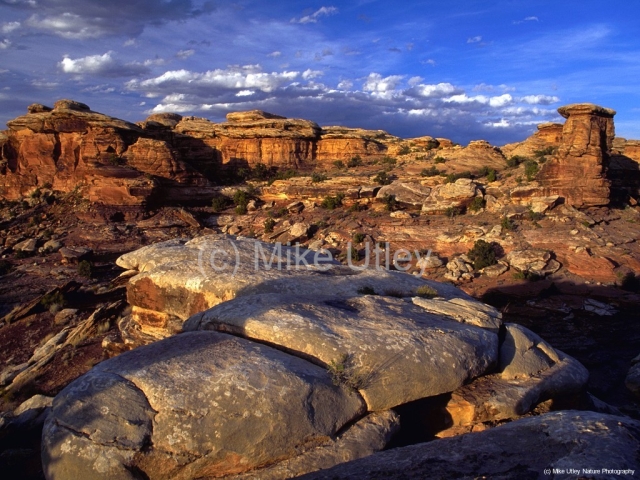
I’ve posted several images from Lisbon Valley in southeast Utah. It’s an out-of-the-way region that lacks the deep canyons and arches of its neighboring national parks, yet it has a charm all its own. While photographing Big Indian Rock years ago, I came upon this large boulder that had tumbled down onto the valley floor below and split apart. Aside from the marvelous texture and color of the boulder, what really struck me was what grew on top: a stunted pinyon pine. These trees, and junipers as well, eke out a hardscrabble existence in the desert of the Colorado Plateau, seemingly surviving in the most inhospitable locales. How this little tree managed to flourish left me nonplussed. I use the word “tenacity” to describe desert life, and it’s an apt term in this instance. This scene spoke to me of isolation, loneliness, determination, tenacity and the will to survive despite the harshest odds. From a technical standpoint, due to the strong direct lighting from the evening sun, the rock face was extremely bright and glary, so I employed a polarizer filter to eliminate the glare in order to allow the texture detail to show. The polarizer also eliminates glare from atmospheric dust particles and haze, thus darkening the sky. This was a conscious choice regarding the sky, as I wanted a deep cobalt blue to provide contrast to the brilliant orange of the boulder. The cirrus clouds added a surreal touch to the sky. The way the shadows blocked up completely black made the color and texture of the rock pop. And the pinyon pine? It seems to glow of its own inner light, a strange sort of confidence and serenity. Despite its hardships and travails, it’s found its peace atop its own personal mountain. (Canon gear, Fuji Velvia ISO 50)



 Silent Pariah