“Columbine Cluster on Talus Slope”

Columbine Cluster on Talus Slope, Alta Lakes, SW Colorado (c) Mike Utley

Alta Lakes are a handful of small alpine lakes in the Uncompahgre National Forest near the town of Telluride in southwest Colorado. Perched above 11,000 feet in elevation, these tiny lakes epitomize the wild, rugged beauty of the Colorado Rockies. As I hiked near the lakes one summer afternoon in the late 1990s, I came across a talus slope at the foot of a cliff near one of the lakes. The broken rocks were painted with multi-hued lichen, and navigation of the slope was treacherous (these rocks were real ankle-breakers). Columbines clung to life amid the slabs of stone, and this particular cluster nestled precariously on the steep slope. The overcast lighting was perfect to enhance and saturate the already brilliant colors of the flowers and lichen and to eliminate harsh shadows—perfect lighting for flower photography. I like how the blossoms and leaves are separated along a diagonal line, and how the textures of the stones just seem to beg to be caressed. The contrast between the harsh, rough surfaces of the rocks and the delicate softness of the blooms and leaves is startling, and shows how tenacious life can be in high-altitude alpine settings. There’s a timeless feeling to this place, a silence that permeates the forest and peaks, an almost reverential hush in which these flowers exist but for a moment in the eternity of the embrace of the mountains. (Canon gear, Fuji Velvia ISO 50)
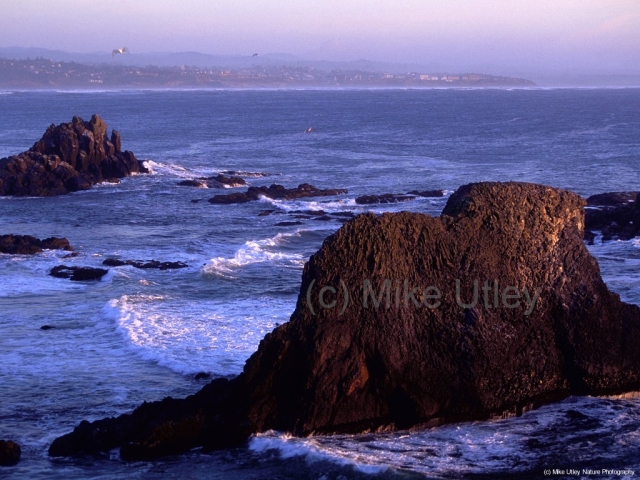
“Sea Stacks Near Newport”

Sea Stacks Near Newport, Yaquina Head State Park, Oregon (c) Mike Utley

The town of Newport is situated along Oregon’s central coast and is home to a few notable attractions such as the Oregon Coast Aquarium and Yaquina Head Lighthouse. During my stay in Oregon in the mid-’90s, I visited both places multiple times. In 1995, Keiko, the orca featured in the film Free Willy, was a resident of the aquarium and I was able to see this majestic killer whale in person. It was both exciting and disturbing to see Keiko as he swam restlessly and dispassionately in his tank, his drooping dorsal fin a sign of possible illness, injury or stress from captivity. He was eventually relocated and reintroduced into the wild off Norway’s coast, where he succumbed to pneumonia in 2003. His story is a sad one, and I was fortunate to be able to see this wonderful orca up close. Yaquina Head Lighthouse is north of Newport and oversees the area like a sentry. On this December evening in 1995, I had my back to the lighthouse as I photographed sea stacks in the bay, with Newport in the distance. The soft lighting rendered the scene in a gentle lavender hue, and as I made this image, a nine-inch-long banana slug meandered by in its slow, lugubrious way to the left of my tripod, leaving a slime trail in its wake. (Canon gear, Fuji Velvia ISO 50)
“Textured Boulder & Big Indian Rock”

Textured Boulder & Big Indian Rock, Lisbon Valley, SE Utah (c) Mike Utley

Lisbon Valley is a red rock desert region in southeast Utah which lies a few miles northwest of the farm on which I was raised. Compared to other nearby desert areas such as Canyonlands and Arches National Parks, it’s rather nondescript, lacking the dramatic deep canyons, arches, pillars and rivers of its neighboring kin, yet it holds a special place in my heart. To me, the valley’s stand-out feature is Big Indian Rock, a blade of sandstone reaching above the sage- and boulder-strewn floor below. During my first visit there with my camera, I was fascinated by a huge, angular slab of red rock which had apparently broken off from Big Indian Rock in the distant past and tumbled to the flats below. This boulder was covered in an incredible array of pits, gouges and mottled patches of lighter and darker tones. My first reaction was to juxtapose this weather-etched pattern with the rock tower in the background. A 24mm f/2.8 wide-angle lens was used to exaggerate the distance between the boulder and the tower, and allowed me to get close enough to the boulder to record its dramatic textures while keeping everything in sharp focus. A polarizing filter was used to eliminate glare from midday rock surfaces in order to better record the colors of the stone, as well as to darken the sky for a more contrasting effect. This image was made in late-March of 1996 and there were patches of snow below the tower (barely visible in this shot), but I recall the day being delightfully pleasant, not just because of the weather, but because it was my introduction to Big Indian Rock and this intriguing “illustrated” boulder. (Canon gear, Fuji Velvia ISO 50)

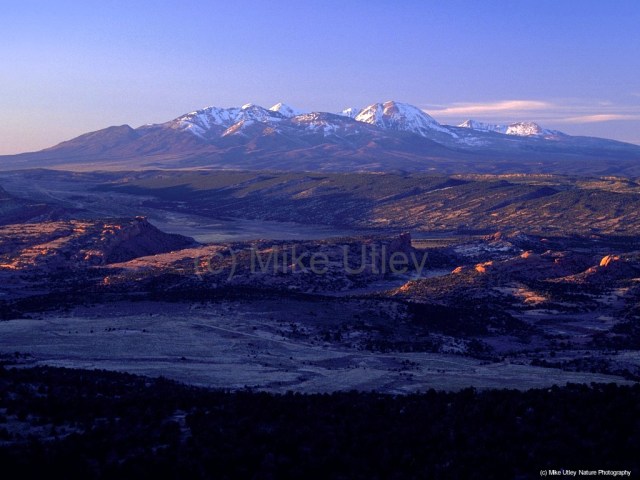
“La Sal Mountains & Lisbon Valley”

La Sal Mountains & Lisbon Valley, SE Utah (c) Mike Utley

Lisbon Valley is located in southeastern Utah and lies a few miles north of the farm on which I was raised. It’s a dynamic landscape of red rock desert and snow-capped mountains that rise incongruously out of nowhere. It’s a place of canyons and sandstone formations, sage brush and rabbit brush, cactus, cheat grass and fox tails, pinyon and juniper trees, as well as coyotes, foxes, mountain lions, jackrabbits and cottontails, mule deer, antelope and elk, hawks, rattlesnakes and other typical desert-dwelling fauna. I photographed this scene from a ridge where the landscape drops off into the desert valley below. Upheaval thrusts are visible, and the La Sal Mountains cling to spring’s last remnants of snow. This image was made in April of 1996 on a bitterly cold late afternoon, where the chill made for numb fingers and frosty exhalations. Metal tripods act as heat sinks during cold weather and freeze hands and fingers. Still, I’m fond of this image as it represents the varied landscape where I was raised. I’ve explored Lisbon Valley numerous times and felt at peace in the vast silence, surrounded by the scents of desert vegetation, warm breezes and clean air, as well as the stark, harsh environment of rock and sand and life that struggles to persist. Lisbon Valley is also home to a large open-pit copper mine (not visible in this image, fortunately) that is extremely unsightly and environmentally hazardous. Local ranchers are rightfully concerned about the high likelihood of contaminated groundwater, but corporate profits are all that seem to matter. Aquifers, habitats, wildlife and natural beauty are no match for some faceless company’s bottom line. (Canon gear, Fuji Velvia ISO 50)
“Western Sword Fern & Spore Pods”

Western Sword Fern & Spore Pods, Silver Falls State Park, Oregon (c) Mike Utley

Silver Falls State Park lies about 24 miles from Salem, Oregon and is home to ten waterfalls along the Trail of Ten Falls loop, with South Falls being the most visited in the park. While exploring near the bowl of South Falls, I came across a particular cluster of western sword ferns which had some of its fronds flipped over by a recent rainstorm. I was immediately fascinated by the multitude of yellow-orange spore pods on the frond’s underbelly. I was raised in an arid region of the southwestern U.S. which was too dry for ferns, so my experience with them was extremely limited. This frond presented both a learning experience and a compositional delight. The long, flowing diagonal line separates the image into lighter and darker halves, and the warmly hued spore pods seem to glow against the cool green background. I always carried a couple of nature guide books in my camera backpack in order to properly identify various plants and animals I’d encounter, and these guides came in handy that day as I’d never before seen a fern with spore pods. This was one of the joys of my nature photography days—discovering things I’d never seen or had never paid attention to before. (Canon gear, Fuji Velvia ISO 50)

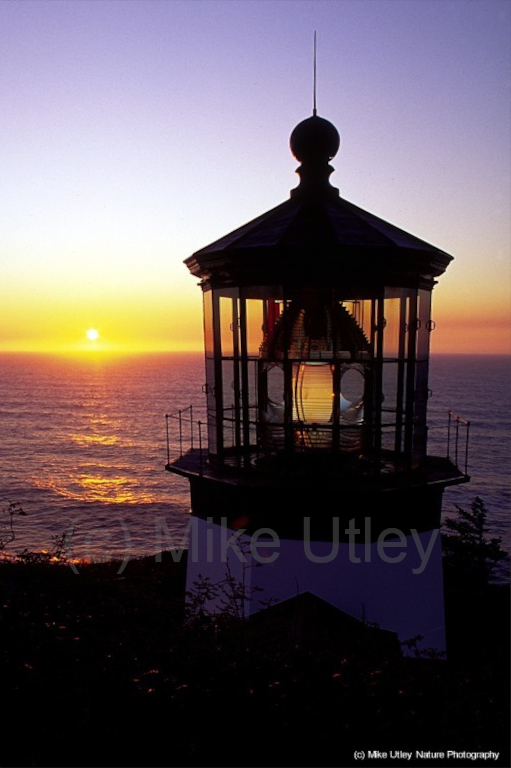
“Cape Meares Lighthouse at Sunset”

Cape Meares Lighthouse at Sunset, Cape Meares National Wildlife Refuge, Oregon Coast (c) Mike Utley

BL1-1(S)–Cape Meares Lighthouse at Sunset, Cape Meares National Wildlife Refuge, Oregon Coast
Cape Meares National Wildlife Refuge sits along the northern Oregon Coast near the town of Tillamook (Tillamook is famous for its cheese). Besides providing a habitat for old-growth forests and breeding seabirds, it’s also notable for beaches loaded with driftwood. Cape Meares lighthouse is perched on the end of a finger of land that juts into the Pacific. The lighthouse isn’t tall—many lighthouses on the rugged Pacific Northwest coast aren’t, due to the elevated headlands upon which they stand), but it provides a wonderful view of the ocean, with a trail that runs behind it offering a perfect perspective of the lighthouse and the sea. I visited Cape Meares one late-autumn afternoon in 1995 and found myself at the lighthouse at the day’s demise. This image depicts what I experienced at that moment. A customer ordered a large print of this photo, and the resulting 16”x20” image was glorious. I mentioned to a friend recently that when I saw the sea for the first time in my life in 1995, I felt as though I had finally come home. That feeling has never changed, and this image is a good reason why. Nothing compares to the sea, a lighthouse and a sunset. (Canon gear, Fuji Velvia ISO 50)

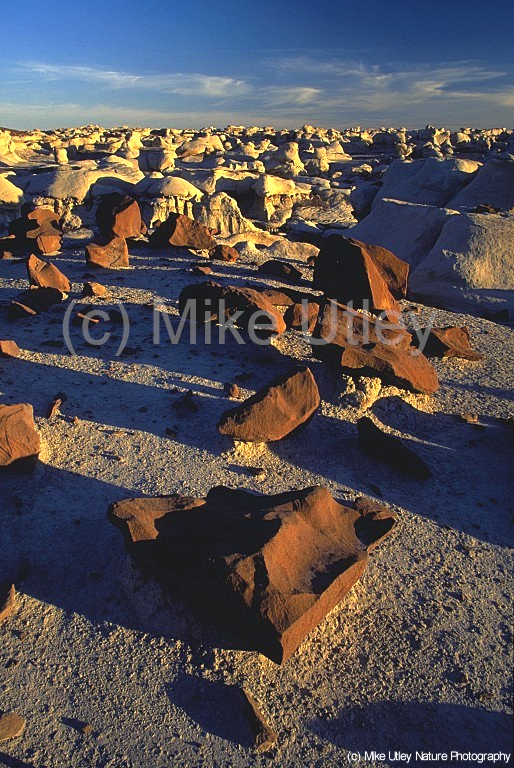
“Brown Fragments & White Hoodoos”

Brown Fragments & White Hoodoos, Bisti Badlands, NW New Mexico (c) Mike Utley

D43-1(S)—Brown Fragments & White Hoodoos, Bisti Badlands, NW New Mexico
The Bisti/De-Na-Zin Wilderness is a sprawling badlands featuring fascinating formations known as hoodoos. These strange formations appear as spires, pillars and other twisted shapes, and consist of sandstone, mudstone, silt, coal and shale. Fossils can be found as well. “Bisti” and “De-Na-Zin” are Navajo for “a large area of shale hills” and “cranes,” respectively. (info courtesy U.S. Bureau of Land Management) I spent an afternoon here a few years ago exploring this remarkable and relatively unknown area about forty miles south of Farmington in northwest New Mexico. Late-evening sunlight drew out the detail in the textures of this barren place of white hoodoos and brown rock fragments. This is a bizarre location. In the midday sun, the rocks are so white it’s painful to look at them. And it’s a good thing it’s a small area because it’s easy to get lost in the labyrinthine confines of the white sandstone formations. In this image, I found remnants of what appeared to be several eroded boulders scattered about, and the russet color contrasted nicely with the white sandstone. The side-lighting created long shadows that gave depth to the scene, and the 24mm f/2.8 wide-angle lens I used created the impression of the hoodoos stretching to infinity. There’s an alien feeling to the Bisti Badlands, an otherworldly sensation of being in an ancient land of living rock. And even though I’m nearly totally deaf, the silence of the place was surreal. (Canon gear, Fuji Velvia ISO 50)

“Cimarron Range & Fall Colors”

Cimarron Range & Fall Colors, Owl Creek Pass, SW Colorado (c) Mike Utley

M19-1(S)—Cimarron Range & Fall Colors, Owl Creek Pass, SW Colorado
Several years ago, while exploring the San Juan Mountains of southwest Colorado near the small town of Ridgway, I came upon Owl Creek Pass. The San Juan Mountains are spectacular as only the Rocky Mountains can be, and Owl Creek Pass was no exception. I’d never driven these backwoods gravel roads and had no idea what I’d stumble upon as I navigated the dusty path. As the evening sun stretched its warm rays across the landscape, I was greeted by the Cimarron Range, located near Silver Jack Reservoir. It was autumn and the fall colors weren’t at their peak, but the aspens tried their best to oblige this day, and the deep blue sky was eager for attention. The blues, greens and yellows played counterpoint to the serrated gray crags of stone, their striations glowing like bands of quicksilver. I like how some of the white aspen trunks are so prominent along the bottom of the frame, and the diagonal split (upper-right to lower-left) between the sky and the earth pleases my eye. Generally, I prefer clouds in a sky to add character, but this sky had such a unique depth and clarity to its hue that it has a fascination all its own. You never know what you’ll find off the beaten path, so when those gravel roads beckon, heed their call. (Canon gear, Fuji Velvia ISO 50)

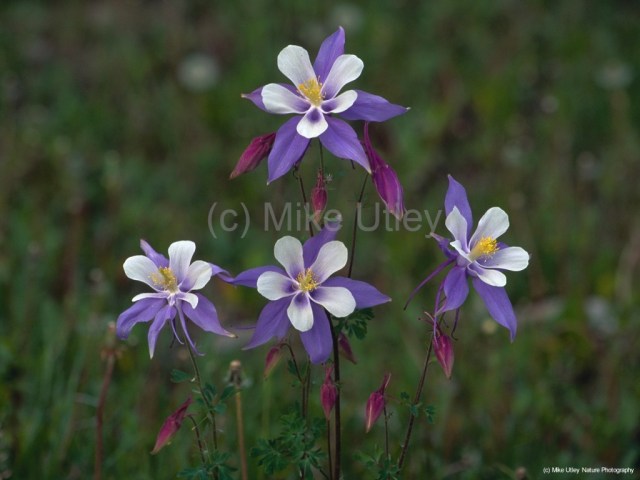
“Rocky Mountain Columbine Cluster”

Rocky Mountain Columbine Cluster, Taylor Mesa, SW Colorado (c) Mike Utley

F39-1(S)—Rocky Mountain Columbine Cluster, Taylor Mesa, SW Colorado
One long-ago overcast summer afternoon I wound my way along a lonely dirt road on Taylor Mesa in the mountains of southwest Colorado. I was looking for wild flowers, and it was the height of the season for columbines. I came upon a lush meadow which was liberally sprinkled with these flowers and others, and as I stopped and began to walk around, this cluster fairly screamed at me for attention. It was as though they had expected my arrival and had dressed up in their Sunday-best and posed for me. I was more than willing to oblige them. The lighting was perfect for wild flower photography—high overcast, no shadows, brilliantly saturated colors—and the verdant green of the meadow provided an ideal background to make the flowers’ colors pop. Columbines are beautiful, but being long-stemmed, they tend to move around in even the merest suggestion of a breeze. Fortune smiled upon me that afternoon, however, and the day was calm and tranquil. In a strange way, the manner in which these four flowers are posed reminds me of a choir, and I can imagine them singing nature hymns in voices only mountains and trees and clouds can hear. (Canon gear, Fuji Velvia ISO 50)

“Sunset at Cape Arago”

Sunset at Cape Arago, Cape Arago State Park, Oregon Coast (c) Mike Utley

W1-2(S)–Sunset at Cape Arago, Cape Arago State Park, Oregon Coast
Cape Arago State Park is located along the southern Oregon Coast between Coos Bay and Bandon. I spent Christmas Eve of 1995 photographing the southern coast in shirt-sleeve weather and ended up at Cape Arago as evening set in. I wasn’t disappointed. The late magic-hour lighting was glorious and painted the cliffs a magnificent orange, while pastel pinks, purples and blues added a delicate touch to the frothing sea. I wasn’t there long enough to explore, unfortunately. I wasn’t able to visit the lighthouse, which was the only one along Oregon’s coast that I missed. I had plans to return to do more photography, but I ended up relocating back to Utah three weeks after this image was made and I haven’t been back to Oregon since. How I miss the Pacific Northwest… It will always be my heaven on Earth. (Canon gear, Fuji Velvia (ISO 50)