
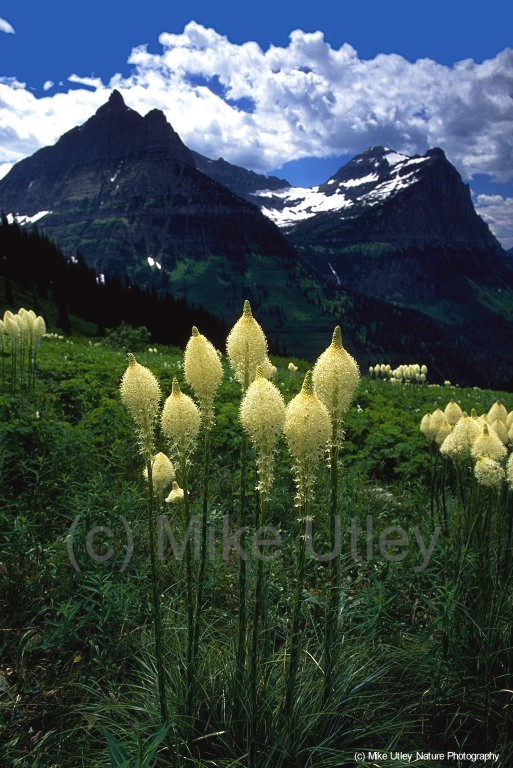
While traveling through Glacier National Park in 1996 along the Going-to-the-Sun Road, this meadow came into view. I’d never seen bear grass before and had no idea what this unusual flower was at the time. The conditions were a bit tricky: contrasting lighting, a bit of a breeze, a slanting hillside, long-stemmed flowers and very slow slide film. In order to record this image, I had to make some choices.
First, due to the breeze, I needed a faster shutter speed than I’d usually use for such a shot with my 24mm f/2.8 wide-angle lens (which I typically closed down to f/22 for such images in order to achieve the most depth-of-field possible). This meant opening up the lens aperture a bit to allow more light to hit the film, which in turn meant a more shallow depth-of-field. Thus, I had to let the distant peaks go slightly out-of-focus and zero in on the bear grass, which was fine since that was the purpose of image anyway, and it caused the flowers to stand out more against the background. Depth-of-field (the amount of a scene—near to far—that’s in sharp focus) is inversely proportional to shutter speed at any given exposure setting: the more DOF, the slower the shutter speed, and vice versa
Second, the contrast between the subdued lighting in the meadow and the brightly lit clouds and peaks required the use of a two-stop soft-edged graduated neutral density filter in order to hold back exposure on the brightly lit sections and allow for a more balanced exposure overall. This slowed the shutter speed even more.
Third, the breeze had these flowers moving constantly and it was a struggle to wait for a lull during which I could expose a frame. Patience is crucial in nature photography since so little is under the photographer’s control—he’s at the mercy of the environment and must wait for the proper conditions to manifest before pressing the shutter button.
Fourth, I had to hold the rectangular graduated neutral density filter in front of the lens by hand since the filter mount was not made for wide-angle lenses and would end up darkening the corners of the frame (vignetting). This was more than a bit awkward and can be hit-and-miss and require several exposed frames to get one that works.
And fifth, all landscape photography requires a level horizon for proper orientation and a natural appearance. When shooting an ocean sunset, for example, it’s easy to use the horizon line as a level since all water lies horizontally. Or, if shooting a copse of trees, the vertical tree trunks can be a level indicator. But sometimes scenes have no obvious level indicator and can confuse the viewer. The slight slope of the meadow caused a problem here, and the solution was to make sure the vertical stems of the bear grass were clearly visible to act as an indicator of a level shot. Better quality tripods have built-in levels, but mine lacked this feature and I had to use environmental objects to imply a sense of proper level orientation.
After all of this, it was a matter of waiting for the breeze to die down enough to fire off a shot. And finally, once the slides were developed I checked my wild flower guidebooks to identify the bear grass. All in all, it took about twenty to thirty minutes to make this image, but it was time well spent. (Canon gear, Fuji Velvia ISO 50)
 Silent Pariah