Hey, friends. Another of my nature photography images titled “Rocky Mountain Columbine Cluster” is now live at Gobblers by Masticadores. Big thanks to editor Manuela Timofte for sharing this image of my all-time favorite wild flower species (it’s also Colorado’s state flower). Much appreciated, Manuela.
You can view the image and its accompanying commentary here:
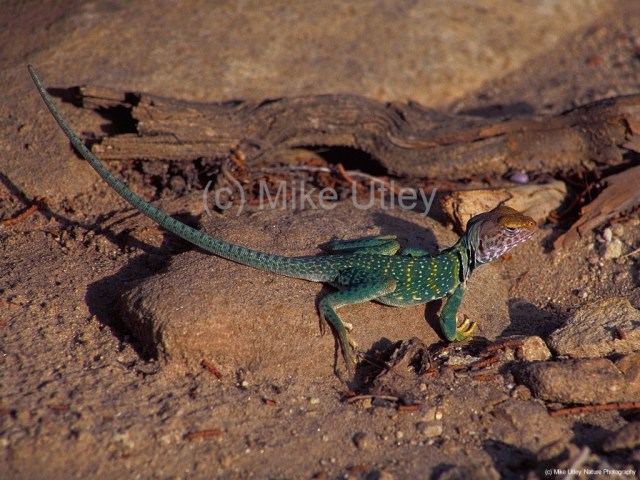
Common Collared Lizard, Hovenweep National Monument, SW Colorado (c) Mike Utley
Hovenweep National Monument is located on a swath of land on Cajon Mesa in the Great Sage Plain that straddles the border of southwest Colorado and southeast Utah less than an hour from where I live. It’s widely known for hosting six extraordinary groups of Ancestral Puebloan villages and a kiva, as well as displaying signs of hunter-gatherers from 8,000-6,000 B.C. through 200 A.D. (Info provided by Wikipedia)
On this day in the early 2000s, I set out to photograph the sandstone towers and other structures, many of which were in surprisingly good condition. The day was clear and hot, and as I hiked from the parking area toward the ruins, I was eager to see the place for the first time and make some images to add to my portfolio.
Alas, nature has a weird fickle streak which makes her unpredictable, and about a half-hour into my hike a sandstorm appeared and intensified with surprising alacrity. I managed to photograph one cylindrical tower amid blowing sand, then jammed my camera inside my shirt to protect it from sand and grit and hoofed it back toward the parking area to wait out the sandstorm in my truck.
On the trail not far from the parking lot, I stumbled across this little guy near a small juniper and some sage brush on the dirt trail. I’d never seen this species of lizard in the wild before, and was unaware of its name. At around ten inches in length, it was larger than the majority of lizards in my area, and its brilliant coloring was fascinating. So, I stopped and set about trying to get some shots of this fellow.
The sandstorm was still blowing dust and grit as I hunkered down to get a decent angle with my 75-300mm lens. The lizard was active, darting about, seeming to run laps around me. It was obviously acclimated to humans, at least to a degree, and it hung around the T-intersection of the trail, flitting about as though it were playing tag with me. After about twenty minutes of stalking this guy amid rapidly changing lighting conditions and several “oohs” and “ahhs” from passers-by, I finally managed to make a couple of images.
The first image here has better composition than the second, while the lighting in the second image is more dynamic than the first. I rarely photographed animals during my nature photography period of 1995-2003 for a couple of reasons. First, as much as I love animals, I prefer landscape photography—I was always very methodical and meticulous in my approach to photography and that meant taking my time to evaluate the scene and make compositional decisions, something that’s more difficult to do when attempting to capture moving animals on film. Second, I simply never had the proper gear to photograph wildlife. Big heavy, fast, expensive lenses are part of a wildlife photographer’s arsenal. I couldn’t afford to spend thousands of dollars on a 300mm f/2.8 lens for wildlife images, and my 75-300mm f/4.0-5.6 zoom wasn’t ideal for subjects in constant motion. Photographing a mountain vista doesn’t require super-fast shutter speeds to freeze the action; photographing a common collared lizard who appears to be on a jittery caffeine-high is a different matter altogether. I was glad to get these two images, and later I checked my field guide to properly identify the species.
Common Collared Lizard, Hovenweep National Monument, SW Colorado (c) Mike Utley
This was more than twenty years ago, and I’ve never seen another common collared lizard. A bit of serendipity, I suppose—I set out to photograph ancient ruins and ended up with lizard images instead. You never know what nature has in store for you. (Canon gear, Fuji Velvia ISO 50)
Sheep Mt. & Beaver Pond, near Trout Lake, SW Colorado (c) Mike Utley
M32-1(S)—Sheep Mt. & Beaver Pond, near Trout Lake, SW Colorado Trout Lake is located near the small town of Telluride in southwest Colorado and is among my favorite places on the planet. This image was made a couple of miles from the lake. The stark contrast between the black water of the beaver pond and the brightly lit snow stretched the exposure limits of the slide film I used, resulting in some blown-out cloud details. Despite this, I like the image. I’m not a winter person by any stretch of the imagination, so I have few winter scenes. This image has the feel of a black-and-white photograph, and the cloud-shaded mountain in the distance adds a brooding, melancholy tone. (Canon gear, Fuji Velvia ISO 50)
Autumn Colors & Early Snow, near Groundhog Reservoir, SW Colorado (c) Mike Utley
FC4-1(S)—Autumn Colors & Early Snow, near Groundhog Reservoir, SW Colorado. Groundhog Reservoir is one of my favorite locations. You can achieve perfect mirror-image reflections of the Lone Cone on its surface at times. Most people go there to fish, hunt or camp, but I always went there to work on photography. The roads are not maintained in the winter months, so it’s only accessible during the summer and fall. This image was made on the way to the reservoir and gives a good idea of what it’s like in my general area. (Canon gear, Fuji Velvia ISO 50)




 Silent Pariah