View South from Arch Rock, Arch Rock State Park, Oregon (c) Mike Utley
Arch Rock State Park is located along the southern Oregon Coast between Gold Beach and Brookings. It features a natural arch just off the shore (not included in this image) where incoming waves burst into whitewater explosions as they shoot through the arch. This image was made in October 1995 on a windy late-afternoon as the light turned golden. This is the view south along the coast, taken minutes before this image which shows the view north from the same immediate area. This scene displays the rugged nature of the Oregon Coast: sheer cliffs which drop into the ocean, sea stacks, forests and cobalt-blue waters. My 24mm wide-angle lens allowed me to include a couple of foreground objects while capturing the infinite horizon beyond. I like the varying shades of blue and green in this image and the way the setting sun seems to gild the cliff faces in a golden sheen. This shot was made just before the rainy season began, which would cloak the coast in overcast skies, fog and rain for much of the next six months or so, but regardless of the weather, the Oregon Coast retains its magical allure and continues to call to me all these years later. (Canon gear, Fuji Velvia ISO 50)
Split Rock & Pinyon Pine, Lisbon Valley, SE Utah (c) Mike Utley
I’ve posted several images from Lisbon Valley in southeast Utah. It’s an out-of-the-way region that lacks the deep canyons and arches of its neighboring national parks, yet it has a charm all its own. While photographing Big Indian Rock years ago, I came upon this large boulder that had tumbled down onto the valley floor below and split apart. Aside from the marvelous texture and color of the boulder, what really struck me was what grew on top: a stunted pinyon pine. These trees, and junipers as well, eke out a hardscrabble existence in the desert of the Colorado Plateau, seemingly surviving in the most inhospitable locales. How this little tree managed to flourish left me nonplussed. I use the word “tenacity” to describe desert life, and it’s an apt term in this instance. This scene spoke to me of isolation, loneliness, determination, tenacity and the will to survive despite the harshest odds. From a technical standpoint, due to the strong direct lighting from the evening sun, the rock face was extremely bright and glary, so I employed a polarizer filter to eliminate the glare in order to allow the texture detail to show. The polarizer also eliminates glare from atmospheric dust particles and haze, thus darkening the sky. This was a conscious choice regarding the sky, as I wanted a deep cobalt blue to provide contrast to the brilliant orange of the boulder. The cirrus clouds added a surreal touch to the sky. The way the shadows blocked up completely black made the color and texture of the rock pop. And the pinyon pine? It seems to glow of its own inner light, a strange sort of confidence and serenity. Despite its hardships and travails, it’s found its peace atop its own personal mountain. (Canon gear, Fuji Velvia ISO 50)
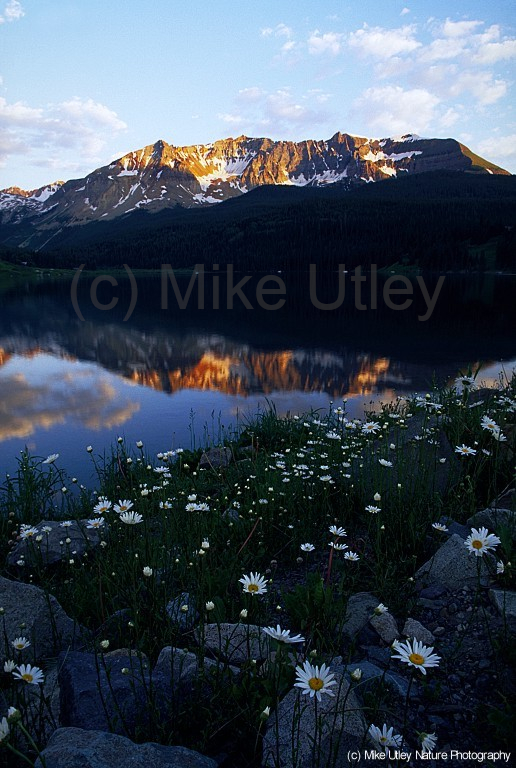
Sheep Mountain & Daisies, Trout Lake, SW Colorado (c) Mike Utley
I have a deep fondness for Trout Lake, located in southwest Colorado near the small tourist town of Telluride, about an hour from where I live. Early mornings and late evenings create some wonderful reflections of Sheep Mountain. I’ve photographed this location many times in all seasons. This image was made in the late ’90s during one fine summer evening when the sky was a gentle shade of pale blue and the daisies proliferated in abundance. I like the tranquility of this scene as the day’s last light illuminates the mountain, and delicate clouds whisper in the sky. I also like how the diagonal lines present in the foreground flowers act as a counterpoint to the horizontal line of the lake’s far shore. I’m reminded of early morning fishing as a kid—trout jumping after insects on the mirror-smooth surface–and years later, hiking among the trees with my camera as I sought to find peace and purpose in my world. It’s an idyllic place. (Canon gear, Fuji Velvia ISO 50)
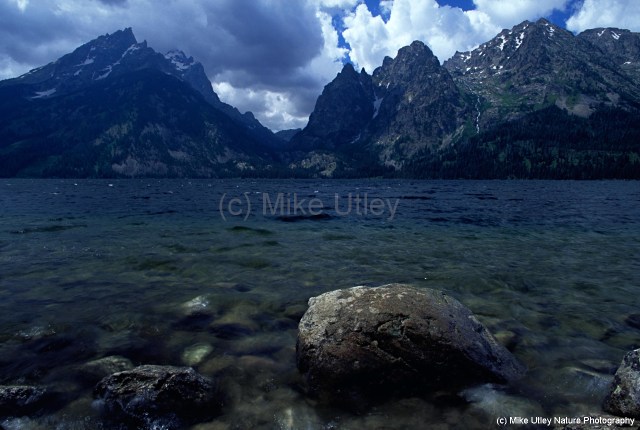
Tetons & Jenny Lake, Grand Teton National Park, Wyoming (c) Mike Utley
In this August 1996 image from my trip up north, I spent a couple of days in Grand Teton National Park in western Wyoming. This is a faerie-tale land of serrated peaks, forests, rivers, lakes and majestic wildlife. On this morning, after a rainy night, clouds obscured the peaks and hung low over the lakes and forest; a brooding presence. It was windy as I scaled the bank of Jenny Lake in order to set up my tripod in the water. I wanted a low angle for my 24mm lens to include the foreground rocks to contrast their smooth textures with the jagged Tetons in the distance. Small whitecaps adorned wavelets as the breeze came in off the lake and blew the clouds from the mountaintops. This is one of my favorite images. I like the raw power of the scene: the basic elements of earth, water and sky, as well as the turbulent motion of the water and clouds. The foreground rocks anchor the image and serve as a tranquil focal point / counterpoint to the chaos in the lake and clouds beyond. I also like the limited color palette here—it almost lends the scene the feeling of a black & white image and allows the viewer to focus more on the shapes and movement of the scene. (Canon gear, Fuji Velvia ISO 50)
I photographed this day lily using my make-shift studio, which consisted of a dark blanket thumb-tacked to the ceiling and soft incidental light from a window. I like the understated tones of the flower in this image, which, in bright sunlight, would look completely different. For me, this image speaks of deep thought and contemplation, as well as the still silence that I always attempted to portray in my photography. Imposing order on a chaotic world was my mission when I was active as a nature photographer, and in my world today, these images feel like a healing balm. Flower photography was one of my favorite disciplines in the field of nature photography, and although this image was made in the living room under controlled conditions, it inspires me in the same way my wild flower images do. Beauty is beauty, after all, regardless of where we find it. It’s up to us to seek it out and allow it to heal our hearts and souls. (Canon gear, Fuji Velvia ISO 50)
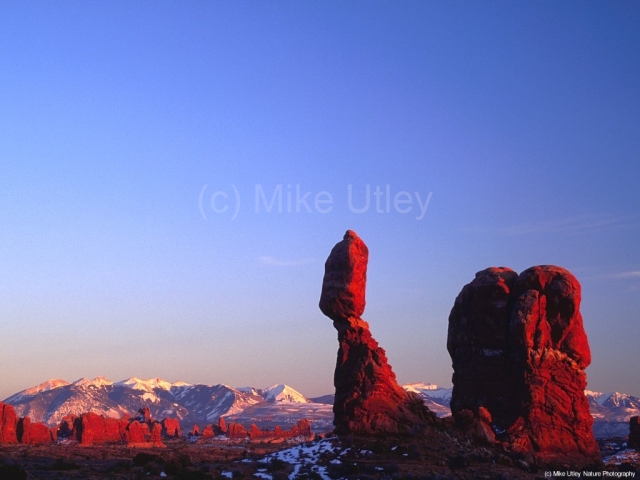
Balanced Rock & La Sal Mountains at Sunset, Arches National Park, SE Utah (c) Mike Utley
Balanced Rock is one of the most notable features in Arches National Park. Rising 128 feet above the desert floor, this curious rock sits precariously atop a sandstone spire, sentry-like, watching over neighboring red rock fins, pillars, arches, and the distant La Sal Mountains. For this image from March 1996, I isolated Balanced Rock and its accompanying tower against the pale winter dusk sky to portray the silent, lonely feeling this icon has always instilled in me. From varying angles, this rock looks remarkably different, and one could almost say its personality changes depending upon one’s vantage point. It inspires contemplation and awe, and speaks to both the tenacity and fragility of this planet. Erosion will eventually topple this rock, but for now it stands in defiance of gravity and the weather. (Canon gear, Fuji Velvia ISO 50)
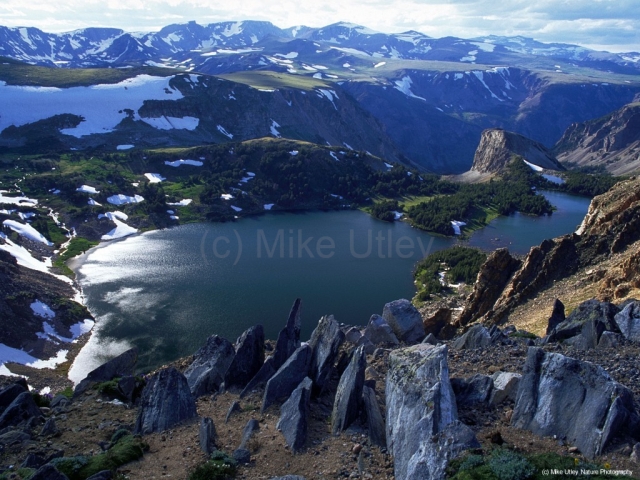
The Absaroka-Beartooth Wilderness is located in south-central Montana, with a small section overlapping into northern Wyoming. This area resides partly in the Gallatin, Custer and Shoshone National Forests. Named after the two predominant and geologically distinct mountain ranges in the area, this region hosts craggy peaks, conifer forests, glaciers and glaciated valleys, alpine tundra plateaus and deep canyons, along with many streams and more than one hundred lakes. The Absaroka Range is volcanic in origin and contains dark rugged peaks and more vegetation, while the Beartooth Range is mostly granite, with sweeping tundra and ground-hugging grasses, wild flowers and lichen.
While driving through this area in August 1996, I was struck by the desolate landscape of the Beartooth Range, bereft of trees in many places, and the patches of snow which linger year-round. I was surprised to find many species of wild flowers that are present in the mountains of my area in southwest Colorado, only much smaller—under five inches in height–miniaturized due to the tundra conditions. This cluster of shark tooth-inspired rock slabs overlooking Twin Lakes in the canyon below caught my eye as an ideal foreground subject for a landscape image. The weather was spitting snow periodically, windy and chilly, and the lighting changed by the minute as thick clouds dragged their shadows across the tundra plateaus. This image isn’t perfect—the lighting was near-impossible to handle due to the brightly lit sky in the distance and rapidly shifting shadowed areas in the scene, hence the inclusion of only a sliver of the sky in this shot. Using a graduated neutral-density filter to attempt to hold back exposure in the sky would have proven futile in this instance—its use would have been painfully obvious, and in nature photography, a natural appearance is of utmost importance. Transparency (slide) film has such a narrow exposure latitude as it is, so I was surprised to end up with a decent image that captured detail throughout in both brightly illuminated and shadowed areas. I like the overall gloomy look of the image, as if portending doom (or just a snowstorm), and I think the jagged rocks in the foreground add so much texture and foreboding personality to the scene. Once again, my beloved 24mm f/2.8 wide-angle lens captured the image I had in my mind, and I was satisfied with the end result of this strange, desolate landscape. (Canon gear, Fuji Velvia ISO 50)
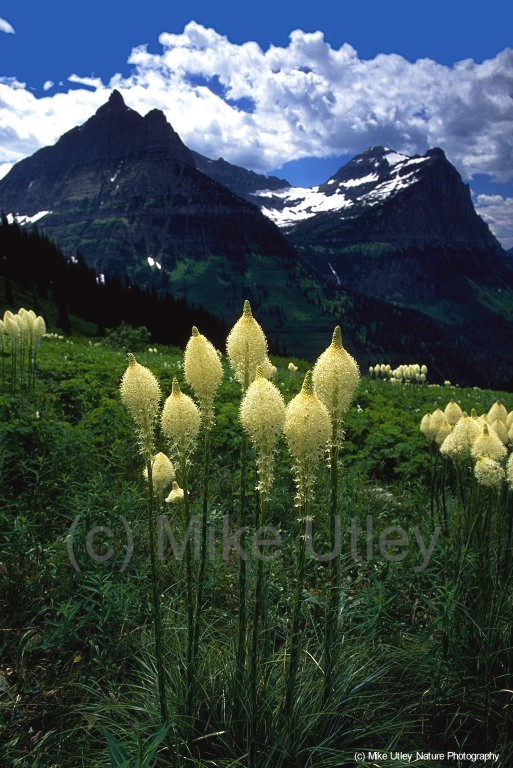
Bear Grass & Peaks, Glacier National Park, Montana (c) Mike Utley
While traveling through Glacier National Park in 1996 along the Going-to-the-Sun Road, this meadow came into view. I’d never seen bear grass before and had no idea what this unusual flower was at the time. The conditions were a bit tricky: contrasting lighting, a bit of a breeze, a slanting hillside, long-stemmed flowers and very slow slide film. In order to record this image, I had to make some choices.
First, due to the breeze, I needed a faster shutter speed than I’d usually use for such a shot with my 24mm f/2.8 wide-angle lens (which I typically closed down to f/22 for such images in order to achieve the most depth-of-field possible). This meant opening up the lens aperture a bit to allow more light to hit the film, which in turn meant a more shallow depth-of-field. Thus, I had to let the distant peaks go slightly out-of-focus and zero in on the bear grass, which was fine since that was the purpose of image anyway, and it caused the flowers to stand out more against the background. Depth-of-field (the amount of a scene—near to far—that’s in sharp focus) is inversely proportional to shutter speed at any given exposure setting: the more DOF, the slower the shutter speed, and vice versa
Second, the contrast between the subdued lighting in the meadow and the brightly lit clouds and peaks required the use of a two-stop soft-edged graduated neutral density filter in order to hold back exposure on the brightly lit sections and allow for a more balanced exposure overall. This slowed the shutter speed even more.
Third, the breeze had these flowers moving constantly and it was a struggle to wait for a lull during which I could expose a frame. Patience is crucial in nature photography since so little is under the photographer’s control—he’s at the mercy of the environment and must wait for the proper conditions to manifest before pressing the shutter button.
Fourth, I had to hold the rectangular graduated neutral density filter in front of the lens by hand since the filter mount was not made for wide-angle lenses and would end up darkening the corners of the frame (vignetting). This was more than a bit awkward and can be hit-and-miss and require several exposed frames to get one that works.
And fifth, all landscape photography requires a level horizon for proper orientation and a natural appearance. When shooting an ocean sunset, for example, it’s easy to use the horizon line as a level since all water lies horizontally. Or, if shooting a copse of trees, the vertical tree trunks can be a level indicator. But sometimes scenes have no obvious level indicator and can confuse the viewer. The slight slope of the meadow caused a problem here, and the solution was to make sure the vertical stems of the bear grass were clearly visible to act as an indicator of a level shot. Better quality tripods have built-in levels, but mine lacked this feature and I had to use environmental objects to imply a sense of proper level orientation.
After all of this, it was a matter of waiting for the breeze to die down enough to fire off a shot. And finally, once the slides were developed I checked my wild flower guidebooks to identify the bear grass. All in all, it took about twenty to thirty minutes to make this image, but it was time well spent. (Canon gear, Fuji Velvia ISO 50)
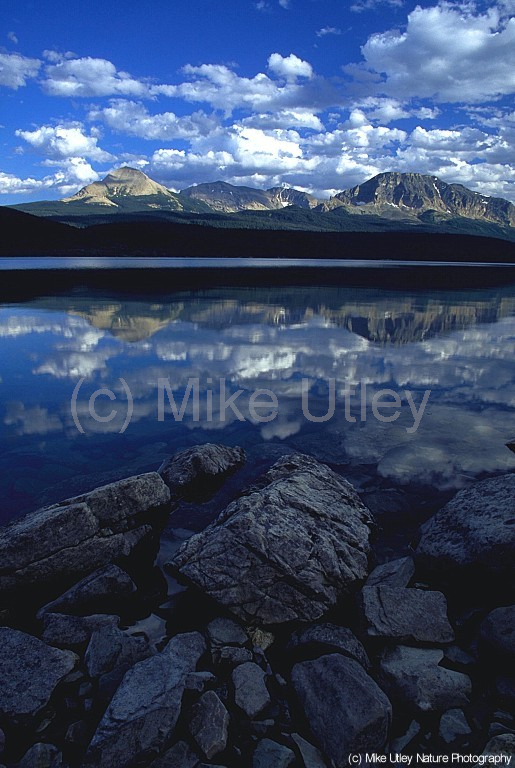
Mountain Reflections at Saint Mary Lake, Glacier National Park, Montana (c) Mike Utley
In August 1996, I made a trip to Montana to see my buddy Jeff. While I was there, we visited Glacier National Park, a sprawling piece of heaven along the northern border of the state. We didn’t have much time—only one day to spend in the park—so making images was a challenge as I was at the mercy of the clock. In the late afternoon of this day, we drove past Saint Mary Lake and, upon seeing the spectacular reflections of the clouds and peaks on the water’s surface, we stopped for a few minutes and I ran across the road and set up my tripod. I wanted to capture the mountain and cloud reflections along with the shaded rocks in the immediate foreground, so my trusty 24mm f/2.8 wide-angle lens was used. The lake was nearly mirror-smooth, and the clouds were sublime. I like the understated personality of the foreground rocks and the overall blue tones of the image. Glacier National Park can’t be experienced properly in one day—indeed, it would take a lifetime to explore—but I did the best with what I was given and I have some good memories of the day. (Canon gear, Fuji Velvia ISO 50)
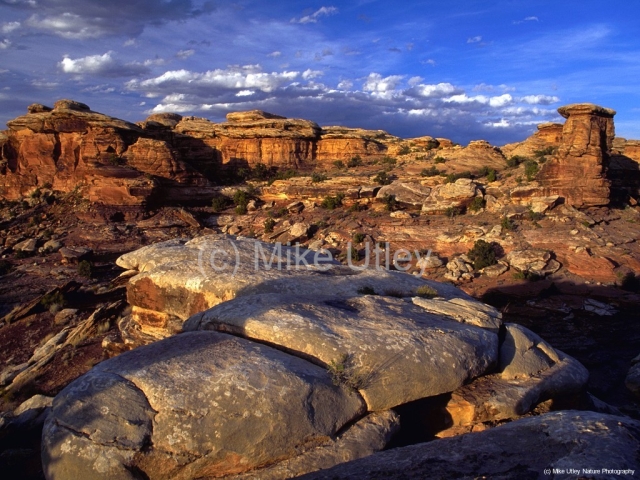
Rocks & Tower at Big Spring Canyon, Canyonlands National Park, SE Utah (c) Mike Utley
Big Spring Canyon, located in Canyonlands National Park in southeast Utah, offers an intimate view of the majesty of the region’s canyon country. It’s a microcosm of the vastness and diversity of the park, sporting canyons, sandstone towers, sheer cliffs, overlooks, and a variety of geological formations. During this particular visit, I caught the late-evening light bathing the landscape in a warm glow as distant storm clouds hovered above the horizon beneath a sheet of cirrus clouds. The multi-layered cloudscape added character to the scene, and the blue sky contrasted nicely with the varied earth tones of the rocks. I like the way the lighter-toned rock in the foreground, replete with lichen whorls, stands out against the darker formations and anchors the scene as the distant brooding clouds ponder the arid landscape. (Canon gear, Fuji Velvia ISO 50)



 Silent Pariah