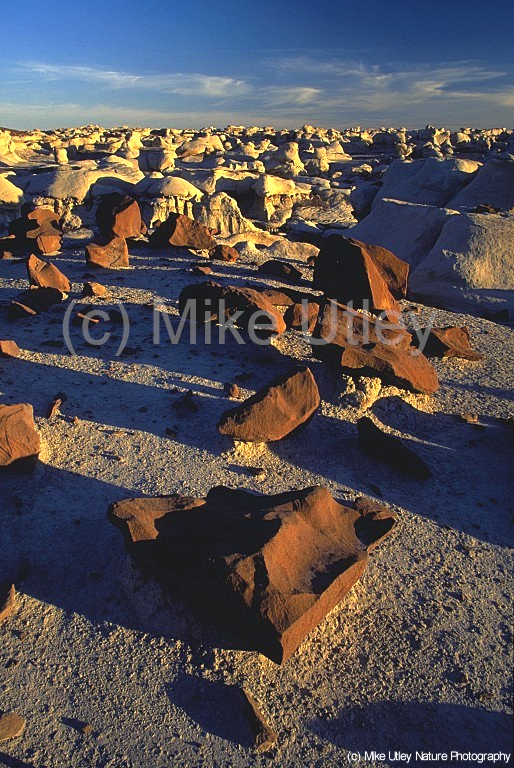
“Brown Fragments & White Hoodoos”

Brown Fragments & White Hoodoos, Bisti Badlands, NW New Mexico (c) Mike Utley

D43-1(S)—Brown Fragments & White Hoodoos, Bisti Badlands, NW New Mexico
The Bisti/De-Na-Zin Wilderness is a sprawling badlands featuring fascinating formations known as hoodoos. These strange formations appear as spires, pillars and other twisted shapes, and consist of sandstone, mudstone, silt, coal and shale. Fossils can be found as well. “Bisti” and “De-Na-Zin” are Navajo for “a large area of shale hills” and “cranes,” respectively. (info courtesy U.S. Bureau of Land Management) I spent an afternoon here a few years ago exploring this remarkable and relatively unknown area about forty miles south of Farmington in northwest New Mexico. Late-evening sunlight drew out the detail in the textures of this barren place of white hoodoos and brown rock fragments. This is a bizarre location. In the midday sun, the rocks are so white it’s painful to look at them. And it’s a good thing it’s a small area because it’s easy to get lost in the labyrinthine confines of the white sandstone formations. In this image, I found remnants of what appeared to be several eroded boulders scattered about, and the russet color contrasted nicely with the white sandstone. The side-lighting created long shadows that gave depth to the scene, and the 24mm f/2.8 wide-angle lens I used created the impression of the hoodoos stretching to infinity. There’s an alien feeling to the Bisti Badlands, an otherworldly sensation of being in an ancient land of living rock. And even though I’m nearly totally deaf, the silence of the place was surreal. (Canon gear, Fuji Velvia ISO 50)
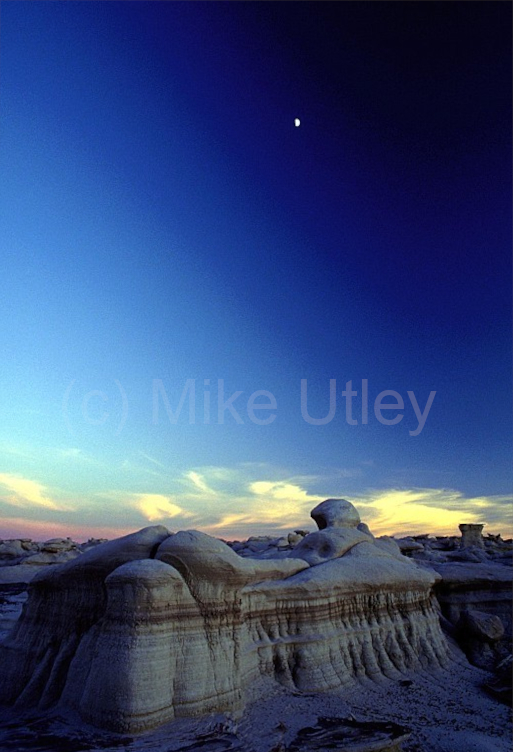
“Rock Formation & Moon at Dusk”

Rock Formation & Moon at Dusk, Bisti Badlands, NW New Mexico (c) Mike Utley

D38-1(S)—Rock Formation & Moon at Dusk, Bisti Badlands, NW New Mexico
The Bisti/De-Na-Zin Wilderness is a sprawling badlands featuring fascinating formations known as hoodoos. These strange formations appear as spires, pillars and other twisted shapes, and consist of sandstone, mudstone, silt, coal and shale. Fossils can be found as well. “Bisti” and “De-Na-Zin” are Navajo for “a large area of shale hills” and “cranes,” respectively. (info courtesy U.S. Bureau of Land Management) I explored this region one day and was amazed at the various shapes and colors of the place. This image is a strange one, however, not because of the rock formations, but due to the bizarre rendering of the evening sky. I used a 24mm f/2.8 wide-angle lens with a polarizer to capture this scene at dusk. A polarizer is a filter that eliminates glare and reflections from surfaces, increases color saturation and contrast, and removes atmospheric haze. Anyone who has worn polarized sun glasses understands this effect. The combination of a polarizer and a wide-angle lens can create some odd sky properties, however, and this can be used for artistic effect as it was here. During the morning and evening hours, the sky displays a range of tones. Wide-angle lenses capture a large swath of the sky and tend to exaggerate this. A polarizer further dramatizes this by darkening sections of the sky by means of eliminating haze, depending on the angle of the lens axis in relationship to the light source. The result can be quite disconcerting, as pictured here. To me, this represents an alien landscape under unfamiliar skies. This same scene without the polarizing effect would be completely different and lack the character this image offers. To top it all off, the moon is depicted as a mere pinprick due to the wide-angle lens, creating a distant, apathetic and lonely feel in the scene. (Canon gear, Fuji Velvia ISO 50)