On a side note, this and other images appear pixelated at Gobblers due to being too small in size to be displayed any larger than 4×6 or so, so please forgive the lack of sharpness—the originals are tack-sharp and can be found on my blog in the Nature Photography section.
You can view the image and its accompanying commentary here:
Hi, everyone. I wanted to let you know another of my nature photography images titled “Sandstone Pillars & La Sal Mountains” has been featured at Gobblers by Masticadores. I truly appreciate Editor Manuela Timofte’s kindness in sharing my passion for nature photography with all of you. Thank you, Manuela.
You can view the image and its accompanying commentary here:
Hi, friends. Recently, I’ve had a couple of my nature photography images titled “Heceta Head Lighthouse” and “Sea Stacks Near Newport” featured at Gobblers by Masticadores. Many thanks to Editor Manuela Timofte for her kindness in sharing my passion for nature photography with all of you. I’m truly grateful, Manuela.
You can view the images and their accompanying commentaries here:
Hi, folks. I’d like to let you know one of my nature photography images titled “Sheep Mountain & Beaver Pond” has been featured at Gobblers by Masticadores. I appreciate Editor Manuela Timofte sharing my passion for nature photography with all of you. Thank you kindly, Manuela. I hope you enjoy seeing the natural world through my eyes.
You can view the image and its accompanying commentary here:
Hey, friends. I’m excited to let you know one of my nature photography images titled “Rock, Sheep Mountain & Trout Lake” has been featured at Gobblers by Masticadores. Many thanks to Editor Manuela Timofte for choosing to share my passion for nature photography with all of you. I’m truly grateful, and I hope you enjoy seeing the natural world through my eyes.
You can view the image and its accompanying commentary here:
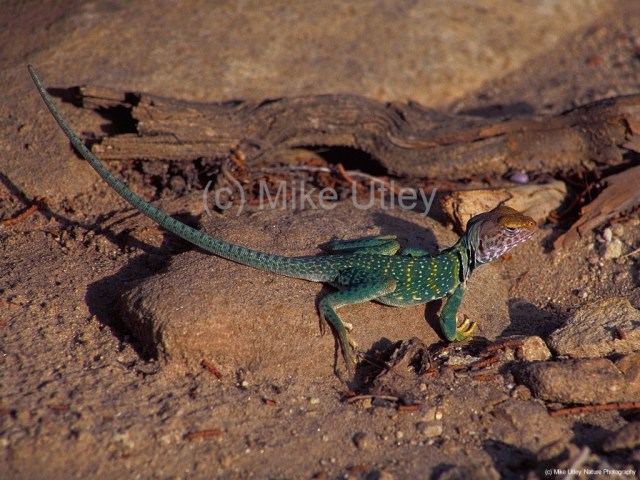
Common Collared Lizard, Hovenweep National Monument, SW Colorado (c) Mike Utley
Hovenweep National Monument is located on a swath of land on Cajon Mesa in the Great Sage Plain that straddles the border of southwest Colorado and southeast Utah less than an hour from where I live. It’s widely known for hosting six extraordinary groups of Ancestral Puebloan villages and a kiva, as well as displaying signs of hunter-gatherers from 8,000-6,000 B.C. through 200 A.D. (Info provided by Wikipedia)
On this day in the early 2000s, I set out to photograph the sandstone towers and other structures, many of which were in surprisingly good condition. The day was clear and hot, and as I hiked from the parking area toward the ruins, I was eager to see the place for the first time and make some images to add to my portfolio.
Alas, nature has a weird fickle streak which makes her unpredictable, and about a half-hour into my hike a sandstorm appeared and intensified with surprising alacrity. I managed to photograph one cylindrical tower amid blowing sand, then jammed my camera inside my shirt to protect it from sand and grit and hoofed it back toward the parking area to wait out the sandstorm in my truck.
On the trail not far from the parking lot, I stumbled across this little guy near a small juniper and some sage brush on the dirt trail. I’d never seen this species of lizard in the wild before, and was unaware of its name. At around ten inches in length, it was larger than the majority of lizards in my area, and its brilliant coloring was fascinating. So, I stopped and set about trying to get some shots of this fellow.
The sandstorm was still blowing dust and grit as I hunkered down to get a decent angle with my 75-300mm lens. The lizard was active, darting about, seeming to run laps around me. It was obviously acclimated to humans, at least to a degree, and it hung around the T-intersection of the trail, flitting about as though it were playing tag with me. After about twenty minutes of stalking this guy amid rapidly changing lighting conditions and several “oohs” and “ahhs” from passers-by, I finally managed to make a couple of images.
The first image here has better composition than the second, while the lighting in the second image is more dynamic than the first. I rarely photographed animals during my nature photography period of 1995-2003 for a couple of reasons. First, as much as I love animals, I prefer landscape photography—I was always very methodical and meticulous in my approach to photography and that meant taking my time to evaluate the scene and make compositional decisions, something that’s more difficult to do when attempting to capture moving animals on film. Second, I simply never had the proper gear to photograph wildlife. Big heavy, fast, expensive lenses are part of a wildlife photographer’s arsenal. I couldn’t afford to spend thousands of dollars on a 300mm f/2.8 lens for wildlife images, and my 75-300mm f/4.0-5.6 zoom wasn’t ideal for subjects in constant motion. Photographing a mountain vista doesn’t require super-fast shutter speeds to freeze the action; photographing a common collared lizard who appears to be on a jittery caffeine-high is a different matter altogether. I was glad to get these two images, and later I checked my field guide to properly identify the species.
Common Collared Lizard, Hovenweep National Monument, SW Colorado (c) Mike Utley
This was more than twenty years ago, and I’ve never seen another common collared lizard. A bit of serendipity, I suppose—I set out to photograph ancient ruins and ended up with lizard images instead. You never know what nature has in store for you. (Canon gear, Fuji Velvia ISO 50)
Scarlet Gilia & Sage Brush, SE Utah (c) Mike Utley
Growing up in the pre-internet era, many folks were subjected to erroneous information that passed its way down through the generations. A quick and convenient Google search wasn’t a thing back then, and unless one had access to a public library or a bookshelf full of encyclopedias, one really had no way of verifying the veracity of that which was told to us by our elders.
This photo featuring scarlet gilia and sage brush is a case in point. For many years, I was told by my mom and her parents at the farm that this flower was honeysuckle. You pluck the blossom from the stem and drink of its nectar, so sure, honeysuckle it must be. Except…it’s not. When I became involved in nature photography in 1995, I bought a guide book for North American plants so I could properly identify what I was photographing. There were clues all along that the info I was receiving from my mom and grandparents was a bit off. They called orange globe mallow flowers “Cheez-Its,” for example, after the tangy cheese cracker, and even as a kid I knew this wasn’t correct. There was no malice involved in these misnomers, of course, just incorrect hand-me-down names for things that were otherwise unidentifiable to folks back then.
I came across this little scene one day in 2014 while on a walk at the farm. I hadn’t done any serious photography for years by that point, although I’d occasionally take my little Canon PowerShot digital camera with me just in case I saw something worth photographing. I had my tripod with me that day, and I composed this image, then went on my way. It wasn’t until I got back to the house and uploaded the image that I realized I had a keeper.
My philosophy with regards to flower photography has always been to shoot in overcast lighting or open shade (tree shadows, etc.) and to avoid bright sunlight. The reason for this is bright sunlight creates harsh, contrasting shadows and tends to bleach-out flower colors, creating an unflattering image, while overcast lighting results in saturated flower colors with even lighting and no shadows for a brilliant color palette. And this philosophy generally holds true. However, there are exceptions, as was the case here. The sun was in a position where it created virtually no annoying shadows in the scene, and the pale-green neutral background of sage served to make the red of the scarlet gilia really pop. This scene, if photographed in overcast conditions, would have been equally acceptable, but the emotional impact would have been completely different. The image below demonstrates the overcast lighting technique for flower photography and how it produces even lighting, no shadows and a vibrant color palette.
Rocky Mountain Columbine, Abajo Mt., SE Utah (c) Mike Utley
Although I informed my mom of the real names of these and other flowers and plants, she continued to use the names she’d been taught as a child, and that was okay, I suppose. I always found it endearing, anyway. (Canon gear)
Tree & Boulders at Sunset, Lisbon Valley, SE Utah (c) Mike Utley
Lisbon Valley is a rather nondescript region in southeast Utah about an hour from the farm on which I was raised, not far from Canyonlands and Arches National Parks. There are no bottomless canyons cutting across the landscape here, no fragile arches standing sentinel over the sage and pinyon and juniper. It’s an out-of-the-way, forgotten place used mainly by ranchers for cattle grazing, and desecrated by a sprawling copper mine. However, it’s an area of special note to me and I spent many afternoons and evenings photographing this place before the copper mine brought its ugly open pit, pollution and truck traffic and destroyed its natural beauty.
This image from the late 1990s is what I call an intimate landscape. It focuses not on grand vistas, but rather a smaller, secluded view, one within arm’s reach. I was fascinated by the contrast between the two adjacent boulders in the foreground, how the doughiness of one appears so starkly different from the smooth, lichen-encrusted texture of the other—an almost surreal juxtaposition. The evening light was a glorious salmon hue with a delicate intensity, a softness often found in desert sunsets.
The thing about these unremarkable locales is that very few people, if any, have ever set foot in much of these areas. People flock to Canyonlands and Arches National Parks for good reason, of course—to be mind-blown by the outrageous showmanship of nature’s rugged chisel and brush, and never even notice these lesser-known places where desert life plays out in secret and beauty on a different scale is on hidden display. I left many footprints in the sands of Lisbon Valley over the years, and always considered it one of my favorite areas for intimate landscapes amid the silence of the stones and the pungent aroma of sage, junper and pinyon. It’s been many years since I last visisted this place, and I fear it’s likely unrecognizable now. My memories live on in my photographs, and they will last forever. (Canon gear, Fuji Velvia ISO 50)
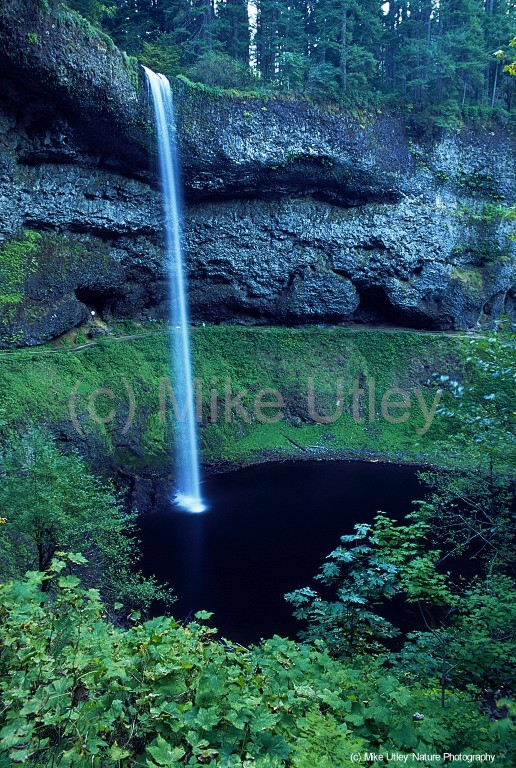
South Falls, Silver Falls State Park, Oregon (c) Mike Utley
Silver Falls State Park is located about 20 miles outside of Salem, Oregon and hosts several falls along the 7.2-mile Trail of Ten Falls. It’s a primordial place, shrouded in mist much of the time, still and quiet save for the whisperings of breezes in trees and the roar of falls when the trail weaves its way near one. South Falls is the park’s most iconic fall at 177 feet, and the nearest to the parking area. The hiking trail winds along the cliffside behind the fall and above the dark pool below. Although I always disliked any signs of humans or human activity in my nature photography, in this case the trail (and at least one person visible on it) serves to provide a sense of scale.
My first visit to Silver Falls State Park in early October 1995 yielded this image (among a few others). The size of the fall was impressive; navigating the trail behind the fall was thrilling (and a little damp) and offered a unique perspective. Oregon has more than 238 waterfalls (and more than 1,000, according to the Northwest Waterfalls Survey), and every one I visited during my all-too-brief time in Oregon was fascinating, from the specatcular fairytale setting of Multnomah Falls along I-84 on the Columbia River Gorge to the little six-foot cascasde I photogrraphed on this very trail shortly after making the above image of South Falls (see below).
Small Cascasde on Hillside, Silver Falls State Park, Oregon (c) Mike Utley
These two images were made just before the rainy season began, when the foliage was still predominantly green and skies were blue. Once the rain comes in Oregon’s autumn, it becomes a fixture throughout the fall, winter and spring. A comparison shot of South Falls below shows the same fall from an almost identical perspective on January 1, 1996 after a heavy rain.
South Falls After Heavy Rains, Silver Falls State Park, Oregon (c) Mike Utley
My time in Oregon was far too short. I came back to Utah in January 1996, always planning on returning to Oregon, dreaming of further explorations and adventures in what I consider the most beautiful state I’ve ever visited. Alas, not all dreams come true, and I’ve never made it back to Oregon. I miss the ocean, the mountains, the forests and the waterfalls. I’m landlocked now, here in southwest Colorado, no longer able to drive due medical issues with my legs, and can no longer explore nature with my camera. It’s a sore loss, indeed, but at least I have my old images to serve as reminders of the joy I experienced back then when I could roam the mountains and deserts and forests and coastlines and commune with nature. (Canon gear, Fuji Velvia ISO 50)
This ongoing initiative showcases blogs with fewer than 500 subscribers which I think are deserving of more attention. Hopefully these blogs will spark your interest and you’ll check them out. It’s my way of spreading awareness of talented writers whose work I admire.
This week’s featured blog is Travelling Therese. I first came across Therese’s blog a couple of years ago when she left a kind comment on one of my nature photography posts. Her blog hooked me immediately. Therese has traveled the world and has documented her adventures as only a seasoned journalist/traveler can. Her posts share in detail the sights and sounds of various locales, and present an intimate portrait of these far-away destinations. I think what initially grabbed my attention was her many entries about her adventures in Japan. Anyone who knows me can tell you I’m fascinated with Asian culture, particularly Japanese culture, and reading Therese’s stories of her Japanese treks allowed me to experience Japan vicariously through her eloquent and in-depth writing and stunning photography.
I asked Therese if she could provide some background about herself and her travels. Here’s what she had to say:
“I am a retired Australian News Journalist, with a continuing keen interest in travelling to explore the world and its cultures. As a Journalist, I never actually worked as a travel writer, and only began writing about my holidays as a hobby.
I have been fortunate enough to achieve my travel dreams since my late teens, back in the early 1970’s, when I backpacked on a shoe string budget, mainly staying in youth hostels. Most of my trips have been self researched and undertaken independently with no assistance from a travel agent.
Researching and putting together a trip is a large part of my travel enjoyment, and I love sharing what I have learnt with others. A camera has always been at my side, so I usually have an abundance of my own travel photos to share on my blog.
I’m still travelling as I move well into older age – Japan has been my main International area of interest for the past 22 years.
My Dad travelled the seas as a young sailor, visiting many countries around the world, until he settled down to a family life. He had wonderful story telling and writing skills, and his travel tales and experiences sparked my own interest in travelling the world. A book he gave me when I was a child – Jules Verne’s Around the World in 80 Days – also was a source of inspiration to travel.
As a young teenager I had two possible careers in mind – Journalism or a travel agent! Luckily, I achieved a Cadetship in Journalism, a well paid job with six weeks holiday time a year that enabled me to travel frequently within Australia and overseas.
By the time I was 25, I had visited 25 countries – some only for a couple of days, others for lengthy periods. I also later lived in Canada for a year and in New Zealand for two years.
Many of my travels when I was younger were embarked on alone. Luckily, my husband has been my travel companion now for many decades, always ready to follow and support my travel ideas.”
On Therese’s travel blog, you’ll find entries on Australia, New Zealand, Japan and Singapore (another Asian destination that holds a special place in my heart). With so many amazing adventures from which to choose, it was difficult for me to decide on a particular post to showcase here, so I’m featuring three, all of which are representative of Therese’s skillful writing and story-telling, as well as her beautiful photography:
Therese’s ability to take her readers by the hand and lead us along with her on her international journeys allows us to experience the joy she feels on her adventures, making Travelling Therese an absolutely wonderful destination of its own. Thank you, Therese, my friend, for showing us the world through your eyes.
Let’s spread the love and support our fellow bloggers.






 Silent Pariah