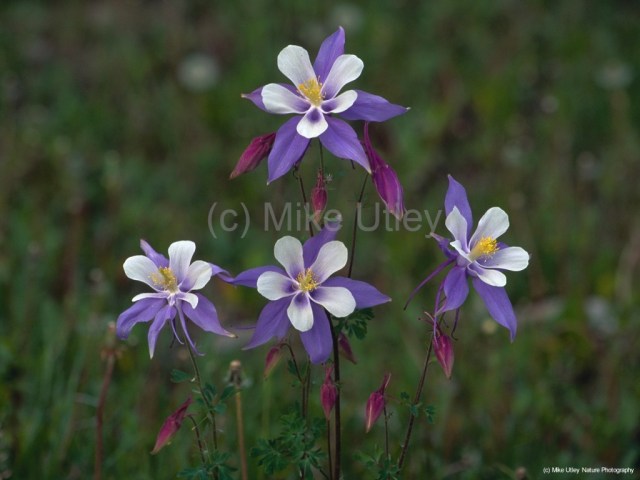
Hey, friends. Another of my nature photography images titled “Rocky Mountain Columbine Cluster” is now live at Gobblers by Masticadores. Big thanks to editor Manuela Timofte for sharing this image of my all-time favorite wild flower species (it’s also Colorado’s state flower). Much appreciated, Manuela.
You can view the image and its accompanying commentary here:
Scarlet Gilia & Sage Brush, SE Utah (c) Mike Utley
Growing up in the pre-internet era, many folks were subjected to erroneous information that passed its way down through the generations. A quick and convenient Google search wasn’t a thing back then, and unless one had access to a public library or a bookshelf full of encyclopedias, one really had no way of verifying the veracity of that which was told to us by our elders.
This photo featuring scarlet gilia and sage brush is a case in point. For many years, I was told by my mom and her parents at the farm that this flower was honeysuckle. You pluck the blossom from the stem and drink of its nectar, so sure, honeysuckle it must be. Except…it’s not. When I became involved in nature photography in 1995, I bought a guide book for North American plants so I could properly identify what I was photographing. There were clues all along that the info I was receiving from my mom and grandparents was a bit off. They called orange globe mallow flowers “Cheez-Its,” for example, after the tangy cheese cracker, and even as a kid I knew this wasn’t correct. There was no malice involved in these misnomers, of course, just incorrect hand-me-down names for things that were otherwise unidentifiable to folks back then.
I came across this little scene one day in 2014 while on a walk at the farm. I hadn’t done any serious photography for years by that point, although I’d occasionally take my little Canon PowerShot digital camera with me just in case I saw something worth photographing. I had my tripod with me that day, and I composed this image, then went on my way. It wasn’t until I got back to the house and uploaded the image that I realized I had a keeper.
My philosophy with regards to flower photography has always been to shoot in overcast lighting or open shade (tree shadows, etc.) and to avoid bright sunlight. The reason for this is bright sunlight creates harsh, contrasting shadows and tends to bleach-out flower colors, creating an unflattering image, while overcast lighting results in saturated flower colors with even lighting and no shadows for a brilliant color palette. And this philosophy generally holds true. However, there are exceptions, as was the case here. The sun was in a position where it created virtually no annoying shadows in the scene, and the pale-green neutral background of sage served to make the red of the scarlet gilia really pop. This scene, if photographed in overcast conditions, would have been equally acceptable, but the emotional impact would have been completely different. The image below demonstrates the overcast lighting technique for flower photography and how it produces even lighting, no shadows and a vibrant color palette.
Rocky Mountain Columbine, Abajo Mt., SE Utah (c) Mike Utley
Although I informed my mom of the real names of these and other flowers and plants, she continued to use the names she’d been taught as a child, and that was okay, I suppose. I always found it endearing, anyway. (Canon gear)
Columbine Cluster on Talus Slope, Alta Lakes, SW Colorado (c) Mike Utley
Alta Lakes are a handful of small alpine lakes in the Uncompahgre National Forest near the town of Telluride in southwest Colorado. Perched above 11,000 feet in elevation, these tiny lakes epitomize the wild, rugged beauty of the Colorado Rockies. As I hiked near the lakes one summer afternoon in the late 1990s, I came across a talus slope at the foot of a cliff near one of the lakes. The broken rocks were painted with multi-hued lichen, and navigation of the slope was treacherous (these rocks were real ankle-breakers). Columbines clung to life amid the slabs of stone, and this particular cluster nestled precariously on the steep slope. The overcast lighting was perfect to enhance and saturate the already brilliant colors of the flowers and lichen and to eliminate harsh shadows—perfect lighting for flower photography. I like how the blossoms and leaves are separated along a diagonal line, and how the textures of the stones just seem to beg to be caressed. The contrast between the harsh, rough surfaces of the rocks and the delicate softness of the blooms and leaves is startling, and shows how tenacious life can be in high-altitude alpine settings. There’s a timeless feeling to this place, a silence that permeates the forest and peaks, an almost reverential hush in which these flowers exist but for a moment in the eternity of the embrace of the mountains. (Canon gear, Fuji Velvia ISO 50)
Rocky Mountain Columbine Cluster, Taylor Mesa, SW Colorado (c) Mike Utley
F39-1(S)—Rocky Mountain Columbine Cluster, Taylor Mesa, SW Colorado One long-ago overcast summer afternoon I wound my way along a lonely dirt road on Taylor Mesa in the mountains of southwest Colorado. I was looking for wild flowers, and it was the height of the season for columbines. I came upon a lush meadow which was liberally sprinkled with these flowers and others, and as I stopped and began to walk around, this cluster fairly screamed at me for attention. It was as though they had expected my arrival and had dressed up in their Sunday-best and posed for me. I was more than willing to oblige them. The lighting was perfect for wild flower photography—high overcast, no shadows, brilliantly saturated colors—and the verdant green of the meadow provided an ideal background to make the flowers’ colors pop. Columbines are beautiful, but being long-stemmed, they tend to move around in even the merest suggestion of a breeze. Fortune smiled upon me that afternoon, however, and the day was calm and tranquil. In a strange way, the manner in which these four flowers are posed reminds me of a choir, and I can imagine them singing nature hymns in voices only mountains and trees and clouds can hear. (Canon gear, Fuji Velvia ISO 50)


 Silent Pariah