Hello, friends. Gobblers by Masticadores has published another of my nature photography images titled “Autumn Colors & Cirrus Clouds.” Many thanks to editor Manuela Timofte for sharing this fall foliage image with her readers.
You can view the image and its accompanying commentary here:
Hi, folks. I’d like to let you know one of my nature photography images titled “Sheep Mountain & Beaver Pond” has been featured at Gobblers by Masticadores. I appreciate Editor Manuela Timofte sharing my passion for nature photography with all of you. Thank you kindly, Manuela. I hope you enjoy seeing the natural world through my eyes.
You can view the image and its accompanying commentary here:
Hey, friends. I’m excited to let you know one of my nature photography images titled “Rock, Sheep Mountain & Trout Lake” has been featured at Gobblers by Masticadores. Many thanks to Editor Manuela Timofte for choosing to share my passion for nature photography with all of you. I’m truly grateful, and I hope you enjoy seeing the natural world through my eyes.
You can view the image and its accompanying commentary here:
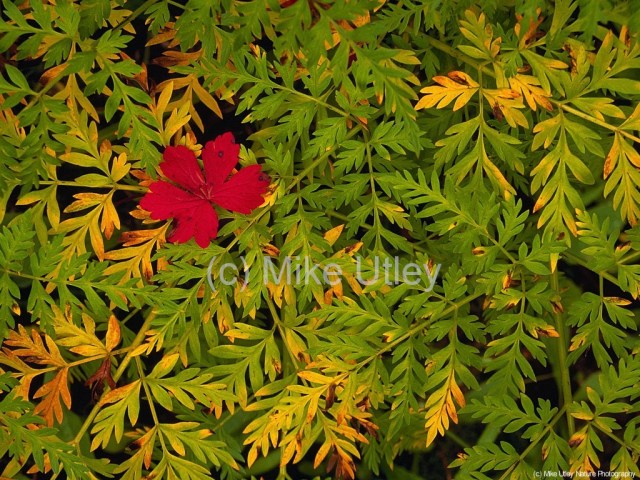
Autumn Leaf & Ferns, near Trout Lake, southwest Colorado (c) Mike Utley
I have a lot of images from Trout Lake in southwest Colorado, about an hour from where I live. Many of these images don’t feature the lake, such as this one of autumn ferns. The area is heavily forested, snuggled deep within the arms of several mountain peaks. In the summer, wild flowers explode in a profusion of color; in the fall, aspens glow a strident yellow that complements the deep greens of conifers and the cobalt blue sky.
On this autumn day in the late 1990s, my mom accompanied me. She enjoyed getting away from the farm whenever she could, and she loved nature drives and breathing fresh mountain air. We took the dirt road that circumscribes the lake and pulled over in a little clearing of ferns among tall pines and spruces. There were a few bright red amanita muscaria mushrooms still stubbornly clinging to life, and while my mom looked at these poisonous fungi (I’d warned her not to touch them), I set about photographing the ferns whose fronds had begun to turn yellow. On the ground nearby, a small leaf the color of arterial blood caught my eye, and I saw an opportunity to show my mom one of the standard composition guidelines of photography: the Rule of Thirds. Not quite a rule as much as a suggestion, the idea is to divide the frame into thirds both vertically and horizontally (like a tic tac toe grid). Placing the main subject on one of the places where these grid lines intersect—the power-points—generally results in a more pleasing image. As with any rule, there are plenty of exceptions. This rule is overused and can produce cliché images that lack depth and emotion, but sometimes the end result is indeed compelling.
I composed the image, placing the crimson leaf on a power-point and explained the theory as my mom looked through the viewfinder. When I got the slides back from the lab and showed her the resultant image on my lightbox, she could hardly contain her excitement. She adored this image and she felt as though she had played a part in its creation. And she was right: every time I look at this image, I’m reminded of her, just the two of us in the little clearing one autumn afternoon, experiencing nature and being glad to be alive. It may appear to be just another pretty picture, but it’s so much more than that. I was able to share my love for nature and photography with her that day, and part of her lives on in this image. (Canon gear, Fuji Velvia ISO 50)
Pussy Willow Catkin on Twig, near Trout Lake, southwest Colorado (c) Mike Utley
Trout Lake, near the small town of Telluride in southwestern Colorado, is my second-favorite spot on Planet Earth, just behind Heceta Head Lighthouse on the central Oregon Coast. I’ve posted a few images of the lake itself, snugly nestled in the laps of Sheep Mountain, Vermilion Peak, Golden Horn and Pilot Knob amid pine and spruce forests, aspens and a cornucopia of wild flowers. A dirt road circumnavigates the lake, wending its way closer to the peaks and through the woods and bogs. A narrow wooden bridge, which had fallen into disrepair the last time I was there, spans a creek halfway around the lake. It was here, near the collapsed bridge, while photographing elkslip and other wild flowers one summer evening in the late 1990s, that I noticed a lone pussy willow catkin perched on a twig.
I’ve always been enamored with these diminutive delights, tiny and soft and so aptly named (honestly, the term “catkin” is sort of giggle-inducing). There were no willows where I lived on the farm so I’d never had the opportunity to photograph these little guys until now. The light was quickly fading so I set to work. The compositional goal was to isolate the twig and catkin against the background by using a wide aperture setting to blur the background into a solid mass of color in order to make the subject stand out as much as possible. I wanted to express a little story with this image, too, a vignette of the early stages of life, its uphill battle to reach maturity, and the uncertainty that awaits all of us at the end. The catkin was placed on a power-point in the lower left, with the gentle upward arc of the twig leading across the frame to…what? What lies ahead? What of that sudden drop-off at the end of the twig? In life, we may think we have a plan, a goal for the future, but in reality we’re all flying blind. At any moment, our own personal twigs may end abruptly, plummeting us into oblivion. I envisioned the tiny catkin feeling trepidation at the beginning of its journey, leaning back in fear…perhaps steeling itself to perform a Naruto run to the end of the twig and take flight into the unknown. In this brief pause on the cusp of its decision, the air was utterly still, and not a sound came from the forest. Even the ever-present mosquitoes held their collective breaths as they awaited what was coming. I like to think the catkin was preparing itself, screwing up its courage, and calming itself in the cool air and verdant green silence of the woods. And then…
…it’s up to you to decide what happened next. I haven’t returned to this place in years. I hope the catkin’s journey was a happy one, and as brief as this blossom’s lifespan may have been in the grand scheme of things, its ethereal beauty fit right at home in the green silence of the forest, among elkslip, wild irises and columbines. (Canon gear, Fuji Velvia ISO 50)
Autumn Colors & Cirrus Clouds, near Dunton, SW Colorado (c) Mike Utley
In October 1997, a coworker at the camera store where I was employed invited me to accompany him for a day of fall colors photography in southwest Colorado. We headed out early and made our way to the off-the-beaten-path area near Dunton, a tiny unincorporated hamlet which sits at about 8,600 feet elevation near the West Fork of the Dolores River in the San Juan Mountains. My friend Robert, an accomplished photographer and former hang-glider pilot, knew the area like the back of his hand, having hiked, fly-fished and photographed there for many years. I’d been through Dunton as a kid but didn’t recall much of it. On this morning, bleary-eyed and exhausted from no sleep the night before (a pox on my insomnia), it was all I could do to keep my eyes open as we navigated the dirt roads in his white Isuzu Trooper. Robert was talkative and I was hard-of-hearing, so the conversation was one-sided. The morning, however, was brilliant, warm with a cobalt-blue sky and a suggestion of a breeze. Colorado is famous for its yellow aspens in the fall, and after a time we found a pleasant spot to stop and hike. And as exhausted as I was, I ended up with a handful of decent images, including this one of a group of aspens on a slanting hillside. I woke up in a hurry when I saw this scene. The contrast of the yellow and pale green leaves and dark blue sky, accentuated by the horsetail cirrus clouds and the neutral-toned grasses, was stunning. I used a polarizer filter to eliminate glare on the leaves, which highlighted the clouds and darkened the sky a bit. The colors popped with an intensity only autumn foliage in Colorado can summon. I made a few other images that morning, but this one stands out to me. The clouds, the contrasting yellows and blues, and the diagonal slope of the hillside all came together to create one of my favorite fall foliage images. (Canon gear, Fuji Velvia ISO 50)
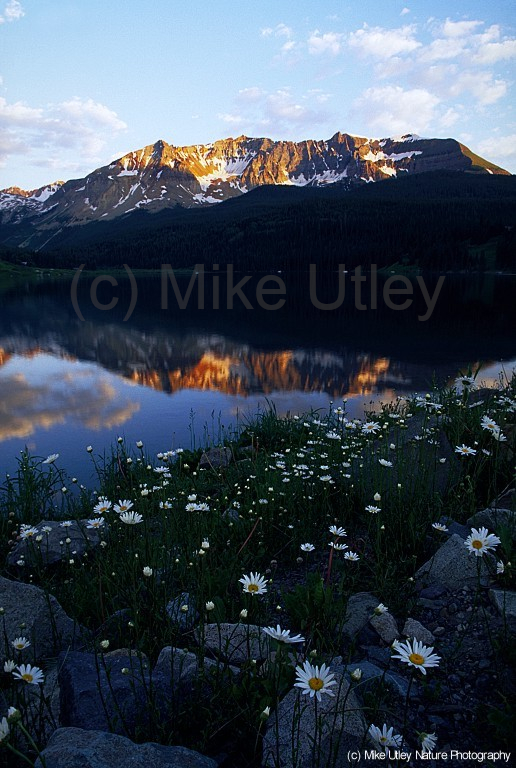
Sheep Mountain & Daisies, Trout Lake, SW Colorado (c) Mike Utley
I have a deep fondness for Trout Lake, located in southwest Colorado near the small tourist town of Telluride, about an hour from where I live. Early mornings and late evenings create some wonderful reflections of Sheep Mountain. I’ve photographed this location many times in all seasons. This image was made in the late ’90s during one fine summer evening when the sky was a gentle shade of pale blue and the daisies proliferated in abundance. I like the tranquility of this scene as the day’s last light illuminates the mountain, and delicate clouds whisper in the sky. I also like how the diagonal lines present in the foreground flowers act as a counterpoint to the horizontal line of the lake’s far shore. I’m reminded of early morning fishing as a kid—trout jumping after insects on the mirror-smooth surface–and years later, hiking among the trees with my camera as I sought to find peace and purpose in my world. It’s an idyllic place. (Canon gear, Fuji Velvia ISO 50)
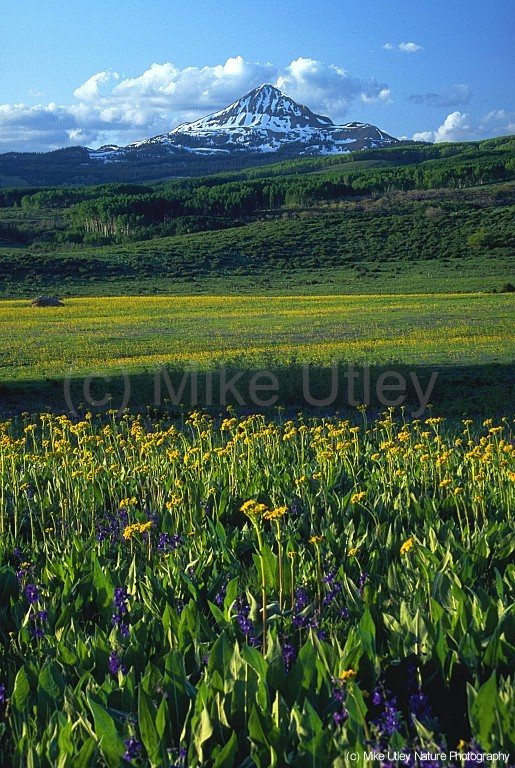
Lone Cone & Wild Flowers, near Groundhog Reservoir, SW Colorado (c) Mike Utley
The Lone Cone is a local icon in southwest Colorado. Located in the San Miguel Mountains about 24 miles from the town of Telluride, its 12,618-foot cone can bee seen from many miles in all directions. It resembles a pyramid on the horizon, and was clearly visible from the farm on which I was raised in southeast Utah. It’s a favorite local attraction of mine and I have several images of this peak. This particular image was made just beyond Groundhog Reservoir, about an hour and a half from where I live. It was early summer of 1995 and the wild flowers (mule’s ears, monkshood and lupine in this case) were just beginning to proliferate in the mountains. This vast meadow leading to the Lone Cone was awash in yellow and purple, and the late-afternoon sun warmed the flowers and the peak while a host of perfect summer clouds caressed the the sky.
This image was selected by the Bureau of Land Management’s Anasazi Heritage Center near Dolores, Colorado for the cover of an archaeology textbook and accompanying CD in the late-1990s. Art Director Wayne Rice used the image as a background and layered several graphic elements on top. The original cloudy sky was removed and replaced with a gradient fill to allow the text to stand out more effectively. I was given proper credit for the use of my photograph on the credits page inside the book.
Textbook Cover–Wayne Rice, BLM
In 2001, this same image was again chosen by the BLM’s Anasazi Heritage Center for a poster commemorating National Archaeology and Historic Preservation Month in May of that year. Once again, Art Director Wayne Rice replaced the sky with a gradient fill and added graphic elements to the image to convey some of the historic aspects of Colorado’s past. A total of 7,000 posters were printed for this project and distributed throughout Colorado. After the release of the posters, I was told that Gale Norton, then-U.S. Secretary of the Interior, had one of the posters on display in her office in Washington D.C. What a thrill this was for me! It’s next to impossible to see, but the last two lines in the credits at the bottom of the poster list my name as the photographer. As a perk for contributing to the project, I received five copies of the poster.
Poster–Wayne Rice, BLM
It was a pleasant experience to work with Wayne Rice at the Anasazi Heritage Center on these two projects, and I was honored to be recognized in the credits of both projects as the creator of the image. Seeing up-close the process of a single image making its way into a finished product was intriguing and satisfying. (Canon gear, Fuji Velvia ISO 50)
Columbine Cluster on Talus Slope, Alta Lakes, SW Colorado (c) Mike Utley
Alta Lakes are a handful of small alpine lakes in the Uncompahgre National Forest near the town of Telluride in southwest Colorado. Perched above 11,000 feet in elevation, these tiny lakes epitomize the wild, rugged beauty of the Colorado Rockies. As I hiked near the lakes one summer afternoon in the late 1990s, I came across a talus slope at the foot of a cliff near one of the lakes. The broken rocks were painted with multi-hued lichen, and navigation of the slope was treacherous (these rocks were real ankle-breakers). Columbines clung to life amid the slabs of stone, and this particular cluster nestled precariously on the steep slope. The overcast lighting was perfect to enhance and saturate the already brilliant colors of the flowers and lichen and to eliminate harsh shadows—perfect lighting for flower photography. I like how the blossoms and leaves are separated along a diagonal line, and how the textures of the stones just seem to beg to be caressed. The contrast between the harsh, rough surfaces of the rocks and the delicate softness of the blooms and leaves is startling, and shows how tenacious life can be in high-altitude alpine settings. There’s a timeless feeling to this place, a silence that permeates the forest and peaks, an almost reverential hush in which these flowers exist but for a moment in the eternity of the embrace of the mountains. (Canon gear, Fuji Velvia ISO 50)
Cimarron Range & Fall Colors, Owl Creek Pass, SW Colorado (c) Mike Utley
M19-1(S)—Cimarron Range & Fall Colors, Owl Creek Pass, SW Colorado Several years ago, while exploring the San Juan Mountains of southwest Colorado near the small town of Ridgway, I came upon Owl Creek Pass. The San Juan Mountains are spectacular as only the Rocky Mountains can be, and Owl Creek Pass was no exception. I’d never driven these backwoods gravel roads and had no idea what I’d stumble upon as I navigated the dusty path. As the evening sun stretched its warm rays across the landscape, I was greeted by the Cimarron Range, located near Silver Jack Reservoir. It was autumn and the fall colors weren’t at their peak, but the aspens tried their best to oblige this day, and the deep blue sky was eager for attention. The blues, greens and yellows played counterpoint to the serrated gray crags of stone, their striations glowing like bands of quicksilver. I like how some of the white aspen trunks are so prominent along the bottom of the frame, and the diagonal split (upper-right to lower-left) between the sky and the earth pleases my eye. Generally, I prefer clouds in a sky to add character, but this sky had such a unique depth and clarity to its hue that it has a fascination all its own. You never know what you’ll find off the beaten path, so when those gravel roads beckon, heed their call. (Canon gear, Fuji Velvia ISO 50)







 Silent Pariah