“Brown Fragments & White Hoodoos”

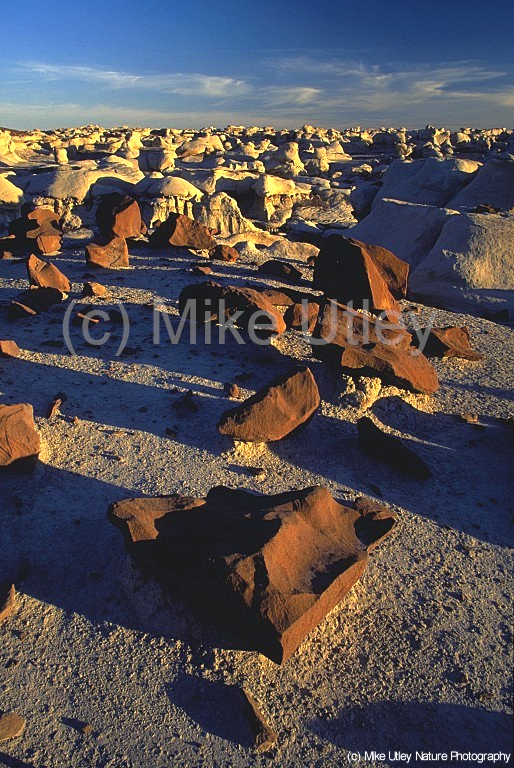
Brown Fragments & White Hoodoos, Bisti Badlands, NW New Mexico (c) Mike Utley

D43-1(S)—Brown Fragments & White Hoodoos, Bisti Badlands, NW New Mexico
The Bisti/De-Na-Zin Wilderness is a sprawling badlands featuring fascinating formations known as hoodoos. These strange formations appear as spires, pillars and other twisted shapes, and consist of sandstone, mudstone, silt, coal and shale. Fossils can be found as well. “Bisti” and “De-Na-Zin” are Navajo for “a large area of shale hills” and “cranes,” respectively. (info courtesy U.S. Bureau of Land Management) I spent an afternoon here a few years ago exploring this remarkable and relatively unknown area about forty miles south of Farmington in northwest New Mexico. Late-evening sunlight drew out the detail in the textures of this barren place of white hoodoos and brown rock fragments. This is a bizarre location. In the midday sun, the rocks are so white it’s painful to look at them. And it’s a good thing it’s a small area because it’s easy to get lost in the labyrinthine confines of the white sandstone formations. In this image, I found remnants of what appeared to be several eroded boulders scattered about, and the russet color contrasted nicely with the white sandstone. The side-lighting created long shadows that gave depth to the scene, and the 24mm f/2.8 wide-angle lens I used created the impression of the hoodoos stretching to infinity. There’s an alien feeling to the Bisti Badlands, an otherworldly sensation of being in an ancient land of living rock. And even though I’m nearly totally deaf, the silence of the place was surreal. (Canon gear, Fuji Velvia ISO 50)

“Cimarron Range & Fall Colors”

Cimarron Range & Fall Colors, Owl Creek Pass, SW Colorado (c) Mike Utley

M19-1(S)—Cimarron Range & Fall Colors, Owl Creek Pass, SW Colorado
Several years ago, while exploring the San Juan Mountains of southwest Colorado near the small town of Ridgway, I came upon Owl Creek Pass. The San Juan Mountains are spectacular as only the Rocky Mountains can be, and Owl Creek Pass was no exception. I’d never driven these backwoods gravel roads and had no idea what I’d stumble upon as I navigated the dusty path. As the evening sun stretched its warm rays across the landscape, I was greeted by the Cimarron Range, located near Silver Jack Reservoir. It was autumn and the fall colors weren’t at their peak, but the aspens tried their best to oblige this day, and the deep blue sky was eager for attention. The blues, greens and yellows played counterpoint to the serrated gray crags of stone, their striations glowing like bands of quicksilver. I like how some of the white aspen trunks are so prominent along the bottom of the frame, and the diagonal split (upper-right to lower-left) between the sky and the earth pleases my eye. Generally, I prefer clouds in a sky to add character, but this sky had such a unique depth and clarity to its hue that it has a fascination all its own. You never know what you’ll find off the beaten path, so when those gravel roads beckon, heed their call. (Canon gear, Fuji Velvia ISO 50)

“A Few Haiku (35)”

(c) 2022 by Michael L. Utley

(#205)

in the forest
nothing matters but the sound
of my quiet mind

…..

(#206)

my heart finds its home
where the sparrows congregate
the vernal canopy

…..

(#207)

time and wind and rain
soften edges of harsh stones
my sorrows assuaged

…..

(#208)

once I saw the sea
there was no more wandering
my home had found me

…..

(#209)

glowing stardew laves
dozing midnight columbines
celestial dreams

…..

(#210)

these numb fingers
have lost their feel for life
my grip weakens

“A Few Haiku (34)”

(c) 2022 by Michael L. Utley

(#199)

domestic abuse
my seven-year-old self
learns to hate

…..

(#200)

sunflower song
a dirge for those
who shall never bloom

…..

(#201)

tank tracks in mud
scrawl across sunflower fields
calligraphy of war

…..

(#202)

spent brass shell casings
golden glitter in the streets
currency of death

…..

(#203)

we watch and wait
while children cry and die
thoughts and prayers are not enough

…..

(#204)

judgment day
we have no excuse for
what we have done

“Rocky Mountain Columbine Cluster”

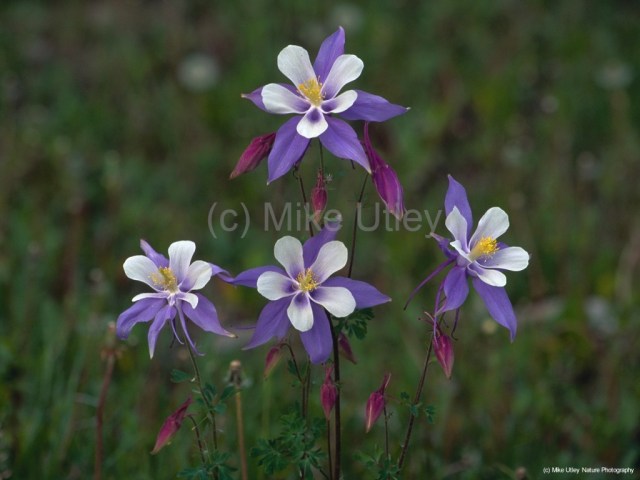
Rocky Mountain Columbine Cluster, Taylor Mesa, SW Colorado (c) Mike Utley

F39-1(S)—Rocky Mountain Columbine Cluster, Taylor Mesa, SW Colorado
One long-ago overcast summer afternoon I wound my way along a lonely dirt road on Taylor Mesa in the mountains of southwest Colorado. I was looking for wild flowers, and it was the height of the season for columbines. I came upon a lush meadow which was liberally sprinkled with these flowers and others, and as I stopped and began to walk around, this cluster fairly screamed at me for attention. It was as though they had expected my arrival and had dressed up in their Sunday-best and posed for me. I was more than willing to oblige them. The lighting was perfect for wild flower photography—high overcast, no shadows, brilliantly saturated colors—and the verdant green of the meadow provided an ideal background to make the flowers’ colors pop. Columbines are beautiful, but being long-stemmed, they tend to move around in even the merest suggestion of a breeze. Fortune smiled upon me that afternoon, however, and the day was calm and tranquil. In a strange way, the manner in which these four flowers are posed reminds me of a choir, and I can imagine them singing nature hymns in voices only mountains and trees and clouds can hear. (Canon gear, Fuji Velvia ISO 50)

“Sunset at Cape Arago”

Sunset at Cape Arago, Cape Arago State Park, Oregon Coast (c) Mike Utley

W1-2(S)–Sunset at Cape Arago, Cape Arago State Park, Oregon Coast
Cape Arago State Park is located along the southern Oregon Coast between Coos Bay and Bandon. I spent Christmas Eve of 1995 photographing the southern coast in shirt-sleeve weather and ended up at Cape Arago as evening set in. I wasn’t disappointed. The late magic-hour lighting was glorious and painted the cliffs a magnificent orange, while pastel pinks, purples and blues added a delicate touch to the frothing sea. I wasn’t there long enough to explore, unfortunately. I wasn’t able to visit the lighthouse, which was the only one along Oregon’s coast that I missed. I had plans to return to do more photography, but I ended up relocating back to Utah three weeks after this image was made and I haven’t been back to Oregon since. How I miss the Pacific Northwest… It will always be my heaven on Earth. (Canon gear, Fuji Velvia (ISO 50)

“Featured Blogger of the Week” at Mitch Teemley’s The Power of Story Blog

Hey, folks. It’s my honor to announce I’ve been selected as the “Featured Blogger of the Week” at Mitch Teemley’s The Power of Story blog. I’d like to thank Mitch for his kindness in recognizing my blog, and would also like to encourage you to visit Mitch’s blog to see the featured post here and more (his blog is exceptionally cool!). Many thanks to Mitch and to all who take the time to read my poetry and view my nature photography. It means the world to me. 🙂

“Rock Formation & Moon at Dusk”

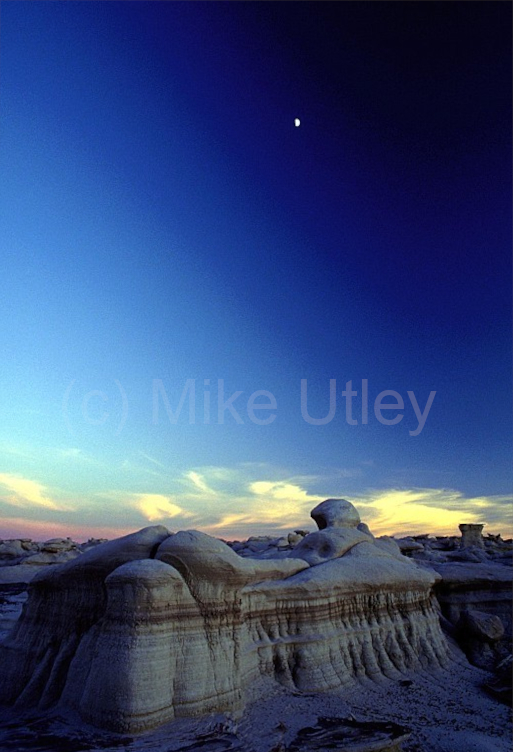
Rock Formation & Moon at Dusk, Bisti Badlands, NW New Mexico (c) Mike Utley

D38-1(S)—Rock Formation & Moon at Dusk, Bisti Badlands, NW New Mexico
The Bisti/De-Na-Zin Wilderness is a sprawling badlands featuring fascinating formations known as hoodoos. These strange formations appear as spires, pillars and other twisted shapes, and consist of sandstone, mudstone, silt, coal and shale. Fossils can be found as well. “Bisti” and “De-Na-Zin” are Navajo for “a large area of shale hills” and “cranes,” respectively. (info courtesy U.S. Bureau of Land Management) I explored this region one day and was amazed at the various shapes and colors of the place. This image is a strange one, however, not because of the rock formations, but due to the bizarre rendering of the evening sky. I used a 24mm f/2.8 wide-angle lens with a polarizer to capture this scene at dusk. A polarizer is a filter that eliminates glare and reflections from surfaces, increases color saturation and contrast, and removes atmospheric haze. Anyone who has worn polarized sun glasses understands this effect. The combination of a polarizer and a wide-angle lens can create some odd sky properties, however, and this can be used for artistic effect as it was here. During the morning and evening hours, the sky displays a range of tones. Wide-angle lenses capture a large swath of the sky and tend to exaggerate this. A polarizer further dramatizes this by darkening sections of the sky by means of eliminating haze, depending on the angle of the lens axis in relationship to the light source. The result can be quite disconcerting, as pictured here. To me, this represents an alien landscape under unfamiliar skies. This same scene without the polarizing effect would be completely different and lack the character this image offers. To top it all off, the moon is depicted as a mere pinprick due to the wide-angle lens, creating a distant, apathetic and lonely feel in the scene. (Canon gear, Fuji Velvia ISO 50)

“Chimney Rock & Courthouse Mountain”

Chimney Rock & Courthouse Mountain, Owl Creek Pass, SW Colorado (c) Mike Utley

M20-1(S)—Chimney Rock & Courthouse Mountain, Owl Creek Pass, SW Colorado
Years ago, I was exploring near Ridgway, a tiny town in the San Juan Mountains of southwest Colorado. I had photographed the famous Sneffels Range prior to that and was driving along and noticed a sign that said “Owl Creek Pass.” On a lark, I took the road and sort of stumbled across this scene in the Cimarron Range. I’d never heard of Chimney Rock and Courthouse Mountain and was surprised I’d never seen it in any of my photography books, magazines or calendars (this was during my pre-internet days). It’s a startlingly majestic place. I was there just as the leaves were turning, but it was a bit early as far as capturing the brilliant fall colors of that area. This is a place I’d love to revisit to observe its changing personality during different seasons and weather. The San Juan Mountains are world-renown for stunningly beautiful landscapes that would take a lifetime to photograph. (Canon gear, Fuji Velvia ISO 50)

“Miniature Pot Rose”

Miniature Pot Rose, SE Utah (c) Mike Utley

F65-1(S)–Miniature Pot Rose, SE Utah
I don’t have many studio images, which makes sense because I never had a studio or a proper lighting kit. I learned to improvise. I photographed this miniature pot rose in the living room in a make-shift studio many years ago. I thumb-tacked a dark blanket to the ceiling to provide a black background and used lighting from a west-facing window to illuminate the rose. I also employed a whiteboard reflector to bounce some fill-light onto the flower to eliminate harsh shadows. I like the sensuous curve of the stem and the hint of leaves at the bottom. The blood-red hue of the petals really stands out against the dark background. The blossom of the rose was only about an inch in diameter. I’ve always loved flower photography, whether it was in the field or a temporary studio indoors. The advantage of shooting flowers indoors is that I could control the elements (no wind, customized lighting, etc.). I prefer wild flower images made out-of-doors, however. The experience is more profound as I have nature’s symphony of sights, scents and sounds all around me as I compose a shot. Still, I love this image. It is natural beauty even if it was made in an ad hoc living room studio years ago. (Canon gear, Fuji Velvia ISO 50)