I’d like to announce my poem “I Did This” has been published at Gobblers By Masticadores. A big thank you to Manuela Timofte and her staff for this opportunity to share my poetry with their readers—it’s always an honor and I’m truly grateful. Thanks, Manuela!
“I did this A handful of fear and feathers The black eye of God Dulling Fading Misting Silent A handful of blood and feathers I did this
A tiny universe Gasping for breath Grasping for death Stopped cold By the golden orb of fate…”
You can read the rest of my poem by clicking this link. Also, don’t forget to follow and subscribe to Gobblers By Masticadores, where you’ll find some wonderful writing and plenty of food for thought.
Hi, everyone. Juan Re Crivello, owner/publisher/editor at Gobblers by Masticadores, was nice enough to republish my recent interview at Spillwords Press for his readers to view. So, if any of you missed it at Spillwords Press and would like to read it, you can find it here:
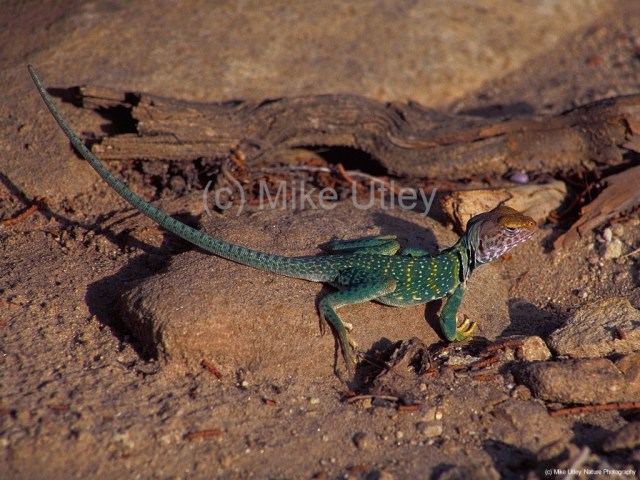
Common Collared Lizard, Hovenweep National Monument, SW Colorado (c) Mike Utley
Hovenweep National Monument is located on a swath of land on Cajon Mesa in the Great Sage Plain that straddles the border of southwest Colorado and southeast Utah less than an hour from where I live. It’s widely known for hosting six extraordinary groups of Ancestral Puebloan villages and a kiva, as well as displaying signs of hunter-gatherers from 8,000-6,000 B.C. through 200 A.D. (Info provided by Wikipedia)
On this day in the early 2000s, I set out to photograph the sandstone towers and other structures, many of which were in surprisingly good condition. The day was clear and hot, and as I hiked from the parking area toward the ruins, I was eager to see the place for the first time and make some images to add to my portfolio.
Alas, nature has a weird fickle streak which makes her unpredictable, and about a half-hour into my hike a sandstorm appeared and intensified with surprising alacrity. I managed to photograph one cylindrical tower amid blowing sand, then jammed my camera inside my shirt to protect it from sand and grit and hoofed it back toward the parking area to wait out the sandstorm in my truck.
On the trail not far from the parking lot, I stumbled across this little guy near a small juniper and some sage brush on the dirt trail. I’d never seen this species of lizard in the wild before, and was unaware of its name. At around ten inches in length, it was larger than the majority of lizards in my area, and its brilliant coloring was fascinating. So, I stopped and set about trying to get some shots of this fellow.
The sandstorm was still blowing dust and grit as I hunkered down to get a decent angle with my 75-300mm lens. The lizard was active, darting about, seeming to run laps around me. It was obviously acclimated to humans, at least to a degree, and it hung around the T-intersection of the trail, flitting about as though it were playing tag with me. After about twenty minutes of stalking this guy amid rapidly changing lighting conditions and several “oohs” and “ahhs” from passers-by, I finally managed to make a couple of images.
The first image here has better composition than the second, while the lighting in the second image is more dynamic than the first. I rarely photographed animals during my nature photography period of 1995-2003 for a couple of reasons. First, as much as I love animals, I prefer landscape photography—I was always very methodical and meticulous in my approach to photography and that meant taking my time to evaluate the scene and make compositional decisions, something that’s more difficult to do when attempting to capture moving animals on film. Second, I simply never had the proper gear to photograph wildlife. Big heavy, fast, expensive lenses are part of a wildlife photographer’s arsenal. I couldn’t afford to spend thousands of dollars on a 300mm f/2.8 lens for wildlife images, and my 75-300mm f/4.0-5.6 zoom wasn’t ideal for subjects in constant motion. Photographing a mountain vista doesn’t require super-fast shutter speeds to freeze the action; photographing a common collared lizard who appears to be on a jittery caffeine-high is a different matter altogether. I was glad to get these two images, and later I checked my field guide to properly identify the species.
Common Collared Lizard, Hovenweep National Monument, SW Colorado (c) Mike Utley
This was more than twenty years ago, and I’ve never seen another common collared lizard. A bit of serendipity, I suppose—I set out to photograph ancient ruins and ended up with lizard images instead. You never know what nature has in store for you. (Canon gear, Fuji Velvia ISO 50)
Hey, folks. I’d like to announce my poem “Fade” has been published at Gobblers By Masticadores. A big thank you to Juan Re Crivello and Manuela Timofte and their staff for this opportunity to share my poetry with their readers—it’s always an honor and I’m truly grateful.
“Fade” (c) 2021 by Michael L. Utley
“Dusk has fallen as Stars scream heavenward and doves Murmur mournfully Evening-song has come and I Cannot hear day’s parting cry
Night blooms above as Insects whisper mysteries And wolves share solemn Oaths on phantom breeze and I Cannot hear dark’s somber sigh…”
You can read the rest of my poem by clicking this link. Also, don’t forget to follow and subscribe to Gobblers By Masticadores, where you’ll find some wonderful writing and plenty of food for thought.
Hey, folks. Spillwords Press has decided to feature me in its “Spotlight on Writers” interview series today, a thrilling and humbling experience for me. I want to thank Dagmara K. and her team for this opportunity to share a bit about myself, my background and what inspires me to create. If you’d like to read the interview, you can find it by clicking this link:
It’s truly an honor to have my poetry and this interview published at Spillwords Press, and I’m delighted and grateful for the chance to connect with readers in this way. I hope you enjoy the interview, and please check out the incredibly talented writers at Spillwords Press, where you’ll find some of the best thought-provoking and moving writing anywhere.
Scarlet Gilia & Sage Brush, SE Utah (c) Mike Utley
Growing up in the pre-internet era, many folks were subjected to erroneous information that passed its way down through the generations. A quick and convenient Google search wasn’t a thing back then, and unless one had access to a public library or a bookshelf full of encyclopedias, one really had no way of verifying the veracity of that which was told to us by our elders.
This photo featuring scarlet gilia and sage brush is a case in point. For many years, I was told by my mom and her parents at the farm that this flower was honeysuckle. You pluck the blossom from the stem and drink of its nectar, so sure, honeysuckle it must be. Except…it’s not. When I became involved in nature photography in 1995, I bought a guide book for North American plants so I could properly identify what I was photographing. There were clues all along that the info I was receiving from my mom and grandparents was a bit off. They called orange globe mallow flowers “Cheez-Its,” for example, after the tangy cheese cracker, and even as a kid I knew this wasn’t correct. There was no malice involved in these misnomers, of course, just incorrect hand-me-down names for things that were otherwise unidentifiable to folks back then.
I came across this little scene one day in 2014 while on a walk at the farm. I hadn’t done any serious photography for years by that point, although I’d occasionally take my little Canon PowerShot digital camera with me just in case I saw something worth photographing. I had my tripod with me that day, and I composed this image, then went on my way. It wasn’t until I got back to the house and uploaded the image that I realized I had a keeper.
My philosophy with regards to flower photography has always been to shoot in overcast lighting or open shade (tree shadows, etc.) and to avoid bright sunlight. The reason for this is bright sunlight creates harsh, contrasting shadows and tends to bleach-out flower colors, creating an unflattering image, while overcast lighting results in saturated flower colors with even lighting and no shadows for a brilliant color palette. And this philosophy generally holds true. However, there are exceptions, as was the case here. The sun was in a position where it created virtually no annoying shadows in the scene, and the pale-green neutral background of sage served to make the red of the scarlet gilia really pop. This scene, if photographed in overcast conditions, would have been equally acceptable, but the emotional impact would have been completely different. The image below demonstrates the overcast lighting technique for flower photography and how it produces even lighting, no shadows and a vibrant color palette.
Rocky Mountain Columbine, Abajo Mt., SE Utah (c) Mike Utley
Although I informed my mom of the real names of these and other flowers and plants, she continued to use the names she’d been taught as a child, and that was okay, I suppose. I always found it endearing, anyway. (Canon gear)
I’d like to let everyone know my poem “It’s Much Too Late” has been published at Gobblers By Masticadores. Sincere thanks to Juan Re Crivello and Manuela Timofte and their staff for this opportunity to share my poetry with their readers—it’s always an honor.
“It’s Much Too Late” (c) 2017 by Michael L. Utley
“Autumn rain Cannot slake Summer’s thirst
It’s much too late For yellowed grass And barren field
Leaves which fall unseen Litter ground in mounds Scarlet memories
It’s much too late For mountain leas Devoid of hue…”
You can read the rest of my poem by clicking this link. Also, don’t forget to follow and subscribe to Gobblers By Masticadores, where you’ll find some wonderful writing and plenty of food for thought.
Tree & Boulders at Sunset, Lisbon Valley, SE Utah (c) Mike Utley
Lisbon Valley is a rather nondescript region in southeast Utah about an hour from the farm on which I was raised, not far from Canyonlands and Arches National Parks. There are no bottomless canyons cutting across the landscape here, no fragile arches standing sentinel over the sage and pinyon and juniper. It’s an out-of-the-way, forgotten place used mainly by ranchers for cattle grazing, and desecrated by a sprawling copper mine. However, it’s an area of special note to me and I spent many afternoons and evenings photographing this place before the copper mine brought its ugly open pit, pollution and truck traffic and destroyed its natural beauty.
This image from the late 1990s is what I call an intimate landscape. It focuses not on grand vistas, but rather a smaller, secluded view, one within arm’s reach. I was fascinated by the contrast between the two adjacent boulders in the foreground, how the doughiness of one appears so starkly different from the smooth, lichen-encrusted texture of the other—an almost surreal juxtaposition. The evening light was a glorious salmon hue with a delicate intensity, a softness often found in desert sunsets.
The thing about these unremarkable locales is that very few people, if any, have ever set foot in much of these areas. People flock to Canyonlands and Arches National Parks for good reason, of course—to be mind-blown by the outrageous showmanship of nature’s rugged chisel and brush, and never even notice these lesser-known places where desert life plays out in secret and beauty on a different scale is on hidden display. I left many footprints in the sands of Lisbon Valley over the years, and always considered it one of my favorite areas for intimate landscapes amid the silence of the stones and the pungent aroma of sage, junper and pinyon. It’s been many years since I last visisted this place, and I fear it’s likely unrecognizable now. My memories live on in my photographs, and they will last forever. (Canon gear, Fuji Velvia ISO 50)




 Silent Pariah