Hello, everyone. I’m happy to let you know that a series of essays I’ve written about my experience as a deaf guy in a hearing world is being published at Gobblers & Masticadores, and the sixth and final installment in the series has gone live today. Sincere thanks to Juan Re Crivello for this opportunity to share my experiences with his readers. Today’s essay is “The Darker Side of Hearing Loss” and you can read it by following this link:
It’s my hope that sharing my life as a deaf person will raise awareness of this “invisible disability” and the impact it has on those of us with hearing loss, and perhaps enlighten those with normal hearing in order to bridge the gap between us. I hope you enjoy it. Once again, much gratitude to Juan Re Crivello for his kindness and generosity. It’s truly an honor for me.
Don’t forget to follow and subscribe to Gobblers & Masticadores, where you’ll find some wonderful writing and plenty of food for thought.
The twitching thing that lay upon the bed Was not my grandfather. It wore his face And smelled of him, old coffee and a trace Of cigarettes. Its eyes were rimmed with red And rheumy and they twinkled in its head Like distant dying stars. And in that place Deep down inside where man and mind embrace My grandfather had lost his mind and fled.
Where did he go, that man I once had known? What horrors did he see, what eldritch lies Ensnared him in the darkness and the din Of lunacy? And was he all alone? He was; I saw it in his weeping eyes And in the tremble of his wretched grin.
The friction between Two blades of grass In a breeze Is enough to Shatter continents The old man said Look there— And he blew his Old man’s breath across the Dead-yellow backyard lawn Africa—gone! Australia—kaput! Antarctica—it were nice knowin ye! And his bib-overalled belly Shook with seismic tremors Of raspy cigarette-scented Laughter And his age-dimmed eyes Almost sparkled in their Crevasse of wrinkles
And I grabbed his sandpaper hand And choked back tears The flavor of oceans And I held my breath Too afraid to breathe
The old man speaks to me Across the decades Soundless words Forever trapped in Ninety frames of Grainy Super-8
He walks away Then turns at my Teenaged beckoning Hey, Grampa! The shutter whirs Like hummingbirds Stealing a flower’s soul Stealing my grandfather’s soul The arcane machinations Bending time and space He is here in my machine He is here
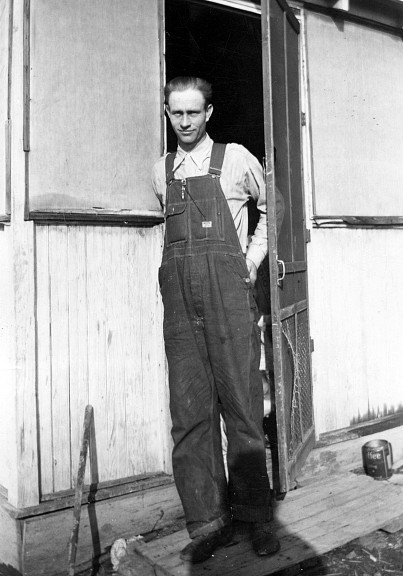
His Viking grin His weathered overalls His sweat-stained cap His cologne of coffee and cigarettes He stops He speaks
I can’t hear his voice
Five seconds He is alive Rewind Five seconds He is alive Rewind
I can’t hear his voice
He speaks to me across the decades The silent film Damning him Damning me I read his lips his eyes his smile I will die soon He seems to say The strokes will be Only the beginning He seems to say Everything will change He seems to say Everything but these Five seconds I have with you And you with me And I am saying Anything you wish Anything you need me to say Anytime you see me here
Recently, I read of a study by Johns Hopkins University concerning the relationship between hearing loss and dementia. According to the study, people with mild hearing loss were twice as likely to experience dementia, those with a moderate loss were three times as inclined, and those with severe hearing loss were five times more prone to develop cognitive issues that fall under the umbrella of dementia. Contributing factors include accelerated atrophy of brain tissue caused by hearing loss as well as the profoundly negative effects of social isolation many deaf people face.
I was vaguely aware of this, having read something about it in the past, but I was not prepared for the statistics this study presented. So, of course, my overly analytical mind seized onto this like a Chihuahua with a squeaky toy and wouldn’t let go. You see, dementia is one of my greatest fears, and I have the dubious honor of hitting the Dementia Trifecta: I have severe hearing loss, major depression and severe chronic insomnia, all three of which are precursors to some form of dementia. Add to this the fact that dementia runs on both sides of my family and you have a nightmare scenario in the making.
I’ve battled major depression for as long as I can remember, dating back to early childhood. Much of this originated due to the severely dysfunctional family in which I was raised. My depression has been, for the most part, resistant to treatment. There’s a brain chemistry component involved, of course, but I’ve never found an anti-depressant that actually did anything to lessen the effects of my depression. Talk therapy helps to a degree, but at one hour every two weeks, it’s not something that has a lot of carry-over during the interim between sessions. PTSD has an effect on my depression as well, and has contributed to the futility I’ve experienced with regards to my inability to make any significant progress in treating my depression. EMDR therapy caused a disturbing negative reaction which left me experiencing several strange physical symptoms, some of which are still present as of this writing.
My sleep disorder has been traced back to one particular incident involving domestic violence when I was eleven years old. It forced me to become hyper-vigilant at an early age and I ended up “training” myself to stay awake until my father went to bed and was asleep. Only then could I know my mother was safe, and only then could I allow myself to try to sleep. However, years of this hyper-vigilance produced insomnia so intense and pervasive that I still suffer from it decades later. Nothing—absolutely nothing—has ever put a dent in my insomnia, and after years of therapy and every treatment method I could find, I finally surrendered to it and accepted that it was not going to go away. And it hasn’t. And its effect on my life is profound.
Of course, the reason I began this blog is because I’m deaf. Hearing loss has such an over-arching impact on one’s life. Those of you reading this who are deaf will understand; those of you who are not cannot understand unless you have a close family member or friend who experiences deafness. Even then, it’s not quite the same as being deaf, but it does offer a uniquely intimate window into the deaf experience.
Deafness is all-encompassing. Everything is affected by it to one degree or another. Everyone knows, for example, that a deaf person has difficulty or a complete inability to enjoy music, but how many hearing people know that hearing loss can affect the way a deaf person walks? Or that it is a possible precursor to the horror of dementia? How many hearing people know that deafness-induced social isolation can lead to issues such as poor eating, addiction, failing physical health due to lack of exercise and self-care, depression, and even heart disease? There’s much more going on here, much more at stake for those who are deaf, than meets the eye (or the ear, as it were).
In my own unique case, there appears to be a nasty synergy occurring among my Big Three Issues: deafness, depression and insomnia. When one gets worse, the others follow suit, thus creating the proverbial “vicious cycle,” and can lead to a snowball effect. When I can’t sleep, my depression worsens, which affects my sleep to a greater degree, which causes my depression to plummet even more, which causes my hearing to suffer from both fatigue and an inability to concentrate deeply enough to lip-read. Also, when I’m lacking sleep, my ears ring much more loudly and incessantly and it actually feels as though my inner ears are feverish. When my remaining hearing suffers like this, it makes my depression worse, and it becomes a situation where it feels as though I’m spiraling downward, caught in some uncanny and surreal maelstrom. When this occurs, the only remedy is sleep, and lots of it. Which, of course, is difficult for me to attain.
What does this have to do with dementia? And am I guaranteed to slip into the darkness of that terrible state of being? I suppose I should explain why this concerns me so much.
My grandmother on my father’s side developed dementia in her ’80s. One of my father’s older sisters followed suit and became so violent that she actually would shoot at people. My father eventually fell into that very same black hole, which ultimately led him to take his own life at age 76. During one of my last interactions with him, in 2015, he was in a paranoid rage, completely out of his mind, and he punched me and threatened to shoot me. I had to file a police report for physical assault. He lied to the police about what happened and they couldn’t charge him because there were no other witnesses. I saw him only twice shortly after that. By the time he killed himself, he was completely in the throes of dementia.
But that’s not really why I’m so concerned. The main reason for my fears of falling prey to this insidious disease has to do with my grandfather on my mother’s side.
I recently posted a trilogy of poems I penned about my grampa, alluding to his descent into dementia. I wrote these pieces out of feelings of both sadness and guilt. Sadness because of never getting to know him as well as I would have liked, and guilt for not being able to force myself to visit him in the nursing home after a series of strokes decimated him and then the indignity of Alzheimer’s Disease settled over him like a filthy cloak, forever obliterating what was left of my grampa.
He was in the hospital after one of his early strokes. My mom, my two sisters and I went to town to visit him. There he was, my big Viking grampa (half-Danish, half-Norwegian), broad shoulders and even broader ever-present grin, sitting on the edge of his hospital bed. He looked normal, seemed happy, appeared fully lucid. My mom was chatting with him and he was smiling as always…and there it was…a facial tic on his right cheek. He didn’t notice it. He continued smiling as my mom talked, and the tic continued for several moments, worsening, twisting my grandfather’s face into something almost obscene. He couldn’t tell what was happening to him, he just sat there on the bed, twitching. I felt the blood leave my head and everything became quiet and I felt my gorge begin to rise and I turned and fled the hospital and ran out to the car, horrified at what I’d just seen. Was that my grandfather in there? Was it really him? It couldn’t have been. The man I’d known all my life could never look like that man I’d seen sitting on the edge of the hospital bed with his face twitching.
It took several minutes for my stomach to settle. Later, my mom and sisters came out to the car and we left for the farm. And that was the last time I ever saw my grampa alive.
Something had broken inside me. I wasn’t sure what it was. Perhaps a good chunk of my innocence had been shattered beyond repair. Whatever it was, I couldn’t bring myself to visit my grampa after that. Every time my mom would drive to town to see him, either in the hospital, or later in the nursing home, I stayed home. I just. Couldn’t. Do. It. The mental image of my grandfather sitting in that hospital room twitching was burned into my mind and all I could do was try to bury it. So, I went to work doing just that, grabbing my shovel and piling tons of guilt on top of it until I was numb. I mean, that wasn’t my grandfather. Not anymore. My grandfather was the guy who always wore bib-overalls and smelled of coffee and cigarettes. My grandfather was the guy who played the accordion and sang Norwegian songs to us, his big grin so expressive and his blue eyes twinkling. He was the guy whose idea of a cup of coffee was about an inch of coffee and the rest a mixture of honey and condensed milk (so sweet you couldn’t even taste the coffee). He was the guy who talked about fishing all the time and made homemade sinkers in his work shed where he also kept his fishing worm farm. He was the guy who taught me to drive in his old black 1949 Dodge truck, double-pump clutch and all. He was the guy who always had a prank to pull, a laugh to bellow, a grin to share. He was the best guy who ever lived. No, that man in the hospital—and later in the nursing home—was not my grandfather. He was an imposter, some thief who had stolen my grampa’s body for his own and had twisted it out of shape and scared the living daylights out of his teenaged grandson.
My grampa died when I was 21. That was the first time I saw him since that horrible day in the hospital years before. He looked peaceful in his casket. He’d lost a lot of weight and was gaunt, but that was him, that was my grampa. That eldritch imposter had finally returned my grandfather’s body to its rightful owner, and we were burying him. It was hard to look at him, but I did. I had to make sure.
I carried around this guilt for years. I loved my grampa dearly, but I had betrayed him. I had left him when he was the most vulnerable, and I hated myself for it. But what could I do? He was gone now and there was no way to tearfully apologize to him for having abandoned him. Toward the very end, he didn’t recognize anyone, so if I’d gone to see him he wouldn’t have known who I was anyway, I told myself in an attempt to quiet that guilt. But guilt is a funny thing. When it gets to yammering, nothing will shut it up.
Well, almost nothing.
In 2012, after having experienced a 20-year fallow period in my writing, I suddenly sat down one night at my computer and began writing again. Poetry this time, unlike in the past when I’d focused on short fiction, back when I was actively submitting my work to publishers and racking up rejection slips. That night was apparently the night my long-absent muse shat on me. For the next month or so, I wrote poetry, piece after piece, and among those pieces were three poems about my grandfather. It was time. Time to deal with years of guilt with regards to the Greatest Grampa Who Ever Lived. The words flowed like tears I’d long-needed to cry but never had been able to. I realized I’d finally found a way to deal with the guilt I’d carried for so long. It hurt, but I was able to honor my grandfather in writing, and it helped more than I could ever have imagined. I recall reading those three poems with my vision blurred with tears from all the memories they evoked. I remembered my old Super-8 film of my grampa smiling and talking to me—silent film, all five seconds of it—and it struck me that he was still there and always would be, no matter where I was or what I was experiencing in my life. All I had to do is close my eyes and remember.
Dementia took my grandfather away. The world is a lesser place without him. And if dementia could fell my grampa, it could take down anyone, including me. And so I worry. I worry that I may suffer the same fate as my grandfather, a fate no one should have to endure, a fate that robbed him of his very essence and robbed the rest of us of the most wonderful man imaginable.
I understand that it’s not a done deal. There’s no guarantee it will happen to me. It skipped my mom, who was lucid and still herself until the end at age 75. But I keep my eyes open for any early signs just in case. I know mine isn’t the only family that has battled this monster. My love goes out to of all those who have gone through this. It’s painful, and the guilt can be crushing, but we will remember those loved ones as they were, and we can honor them in our own unique ways.
The twitching thing that lay upon the bed Was not my grandfather. It wore his face And smelled of him, old coffee and a trace Of cigarettes. Its eyes were rimmed with red And rheumy and they twinkled in its head Like distant dying stars. And in that place Deep down inside where man and mind embrace My grandfather had lost his mind and fled.
Where did he go, that man I once had known? What horrors did he see, what eldritch lies Ensnared him in the darkness and the din Of lunacy? And was he all alone? He was; I saw it in his weeping eyes And in the tremble of his wretched grin.
The friction between Two blades of grass In a breeze Is enough to Shatter continents The old man said Look there— And he blew his Old man’s breath across the Dead-yellow backyard lawn Africa—gone! Australia—kaput! Antarctica—it were nice knowin ye! And his bib-overalled belly Shook with seismic tremors Of raspy cigarette-scented Laughter And his age-dimmed eyes Almost sparkled in their Crevasse of wrinkles
And I grabbed his sandpaper hand And choked back tears The flavor of oceans And I held my breath Too afraid to breathe
The old man speaks to me Across the decades Soundless words Forever trapped in Ninety frames of Grainy Super-8
He walks away Then turns at my Teenaged beckoning Hey, Grampa! The shutter whirs Like hummingbirds Stealing a flower’s soul Stealing my grandfather’s soul The arcane machinations Bending time and space He is here in my machine He is here
His Viking grin His weathered overalls His sweat-stained cap His cologne of coffee and cigarettes He stops He speaks
I can’t hear his voice
Five seconds He is alive Rewind Five seconds He is alive Rewind
I can’t hear his voice
He speaks to me across the decades The silent film Damning him Damning me I read his lips his eyes his smile I will die soon He seems to say The strokes will be Only the beginning He seems to say Everything will change He seems to say Everything but these Five seconds I have with you And you with me And I am saying Anything you wish Anything you need me to say Anytime you see me here

 Silent Pariah