Hi, folks. The estimable Manuela Timofte, editor of Gobblers by Masticadores, has shared another of my nature photography images titled “Rocks & Tower at Big Spring Canyon.” Thank you, Manuela, for publishing this photograph of the high desert region of my part of the world. Very much appreciated.
You can view the image and its accompanying commentary here:
Hello, everyone. Another of my nature photography images titled “Delicate Arch & La Sal Mountains” has been published at Gobblers by Masticadores. Much gratitude to editor Manuela Timofte for sharing this image. I appreciate all you do, Manuela.
You can view the image and its accompanying commentary here:
Hello, everyone. Just a heads-up to let you know one of my nature photography images titled “Textured Boulder & Big Indian Rock” has been featured at Gobblers by Masticadores. Sincere gratitude to editor Manuela Timofte for sharing my nature photos with all of you. Thank you kindly, Manuela.
You can view the image and its accompanying commentary here:
On a side note, this and other images appear pixelated at Gobblers due to being too small in size to be displayed any larger than 4×6 or so, so please forgive the lack of sharpness—the originals are tack-sharp and can be found on my blog in the Nature Photography section.
You can view the image and its accompanying commentary here:
Hi, everyone. I wanted to let you know another of my nature photography images titled “Sandstone Pillars & La Sal Mountains” has been featured at Gobblers by Masticadores. I truly appreciate Editor Manuela Timofte’s kindness in sharing my passion for nature photography with all of you. Thank you, Manuela.
You can view the image and its accompanying commentary here:
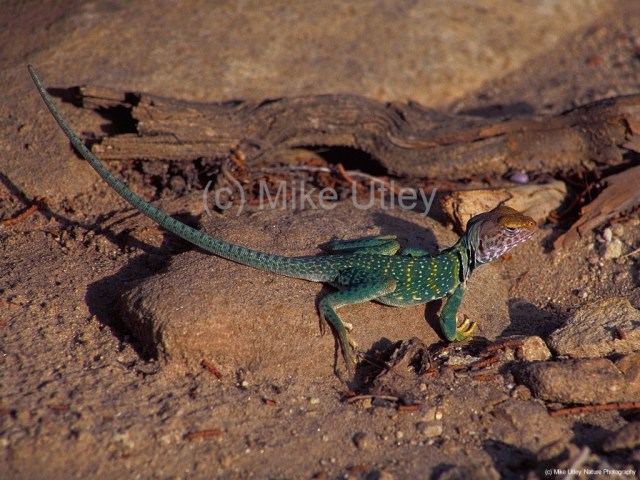
Common Collared Lizard, Hovenweep National Monument, SW Colorado (c) Mike Utley
Hovenweep National Monument is located on a swath of land on Cajon Mesa in the Great Sage Plain that straddles the border of southwest Colorado and southeast Utah less than an hour from where I live. It’s widely known for hosting six extraordinary groups of Ancestral Puebloan villages and a kiva, as well as displaying signs of hunter-gatherers from 8,000-6,000 B.C. through 200 A.D. (Info provided by Wikipedia)
On this day in the early 2000s, I set out to photograph the sandstone towers and other structures, many of which were in surprisingly good condition. The day was clear and hot, and as I hiked from the parking area toward the ruins, I was eager to see the place for the first time and make some images to add to my portfolio.
Alas, nature has a weird fickle streak which makes her unpredictable, and about a half-hour into my hike a sandstorm appeared and intensified with surprising alacrity. I managed to photograph one cylindrical tower amid blowing sand, then jammed my camera inside my shirt to protect it from sand and grit and hoofed it back toward the parking area to wait out the sandstorm in my truck.
On the trail not far from the parking lot, I stumbled across this little guy near a small juniper and some sage brush on the dirt trail. I’d never seen this species of lizard in the wild before, and was unaware of its name. At around ten inches in length, it was larger than the majority of lizards in my area, and its brilliant coloring was fascinating. So, I stopped and set about trying to get some shots of this fellow.
The sandstorm was still blowing dust and grit as I hunkered down to get a decent angle with my 75-300mm lens. The lizard was active, darting about, seeming to run laps around me. It was obviously acclimated to humans, at least to a degree, and it hung around the T-intersection of the trail, flitting about as though it were playing tag with me. After about twenty minutes of stalking this guy amid rapidly changing lighting conditions and several “oohs” and “ahhs” from passers-by, I finally managed to make a couple of images.
The first image here has better composition than the second, while the lighting in the second image is more dynamic than the first. I rarely photographed animals during my nature photography period of 1995-2003 for a couple of reasons. First, as much as I love animals, I prefer landscape photography—I was always very methodical and meticulous in my approach to photography and that meant taking my time to evaluate the scene and make compositional decisions, something that’s more difficult to do when attempting to capture moving animals on film. Second, I simply never had the proper gear to photograph wildlife. Big heavy, fast, expensive lenses are part of a wildlife photographer’s arsenal. I couldn’t afford to spend thousands of dollars on a 300mm f/2.8 lens for wildlife images, and my 75-300mm f/4.0-5.6 zoom wasn’t ideal for subjects in constant motion. Photographing a mountain vista doesn’t require super-fast shutter speeds to freeze the action; photographing a common collared lizard who appears to be on a jittery caffeine-high is a different matter altogether. I was glad to get these two images, and later I checked my field guide to properly identify the species.
Common Collared Lizard, Hovenweep National Monument, SW Colorado (c) Mike Utley
This was more than twenty years ago, and I’ve never seen another common collared lizard. A bit of serendipity, I suppose—I set out to photograph ancient ruins and ended up with lizard images instead. You never know what nature has in store for you. (Canon gear, Fuji Velvia ISO 50)
Tree & Boulders at Sunset, Lisbon Valley, SE Utah (c) Mike Utley
Lisbon Valley is a rather nondescript region in southeast Utah about an hour from the farm on which I was raised, not far from Canyonlands and Arches National Parks. There are no bottomless canyons cutting across the landscape here, no fragile arches standing sentinel over the sage and pinyon and juniper. It’s an out-of-the-way, forgotten place used mainly by ranchers for cattle grazing, and desecrated by a sprawling copper mine. However, it’s an area of special note to me and I spent many afternoons and evenings photographing this place before the copper mine brought its ugly open pit, pollution and truck traffic and destroyed its natural beauty.
This image from the late 1990s is what I call an intimate landscape. It focuses not on grand vistas, but rather a smaller, secluded view, one within arm’s reach. I was fascinated by the contrast between the two adjacent boulders in the foreground, how the doughiness of one appears so starkly different from the smooth, lichen-encrusted texture of the other—an almost surreal juxtaposition. The evening light was a glorious salmon hue with a delicate intensity, a softness often found in desert sunsets.
The thing about these unremarkable locales is that very few people, if any, have ever set foot in much of these areas. People flock to Canyonlands and Arches National Parks for good reason, of course—to be mind-blown by the outrageous showmanship of nature’s rugged chisel and brush, and never even notice these lesser-known places where desert life plays out in secret and beauty on a different scale is on hidden display. I left many footprints in the sands of Lisbon Valley over the years, and always considered it one of my favorite areas for intimate landscapes amid the silence of the stones and the pungent aroma of sage, junper and pinyon. It’s been many years since I last visisted this place, and I fear it’s likely unrecognizable now. My memories live on in my photographs, and they will last forever. (Canon gear, Fuji Velvia ISO 50)
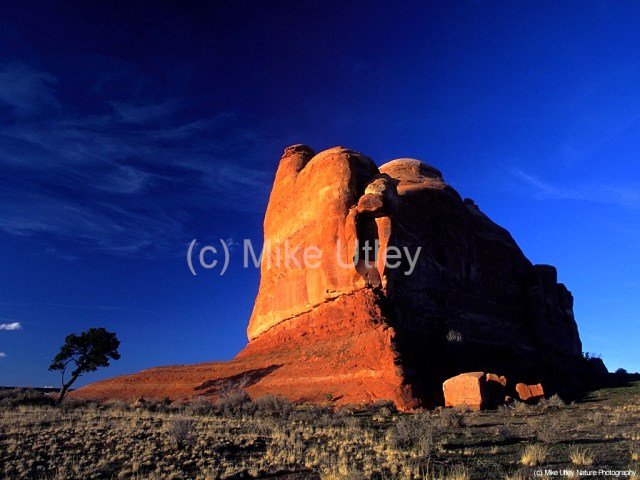
Sandstone Formation & Tree, Lisbon Valley, SE Utah (c) Mike Utley
Lisbon Valley is a relatively nondescript region in southeast Utah near Canyonlands National Park. While its redrock sandstone formations don’t rival the majesty of those found in Canyonlands and Arches National Parks, it has its own hidden marvels, its own unique personality. In the late 1990s, I spotted this rock formation while exploring one late-autumn evening. I was intrigued by several aspects of this scene: the contrasting, opposing oranges and blues; the split-personality of the formation, with half in bright sunset light and the other half in dark shadows; and the looming presence of the formation compared to the diminutive form of the lone juniper tree on the left. And above all, a contemplative stillness. Some might say there’s a David-and-Goliath theme here, a sense of immutable power being challenged by stalwart–if fragile–determination. However, I see something else here…a sense of sorrow, a reaching-out from weakness to strength as the tree casts its shadow on the base of the tower in supplication, as if seeking consolation. A sense of loneliness and isolation. I identify with that juniper tree. I feel deeply that sense of yearning to be a part of something but always finding myself standing on the outside, looking in. Try as it might, the closest that tree will ever come to connecting with that rock is by casting its shadow upon it once a day just before the cold night falls. Such is life in the desert; such is life in this world. (Canon gear, Fuji Velvia ISO 50)
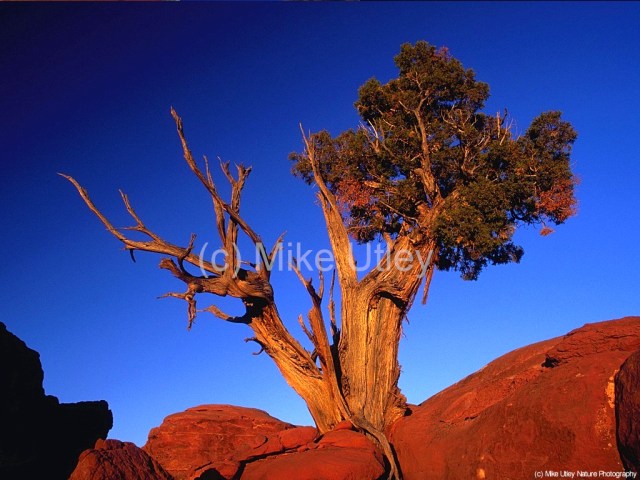
Juniper Tree on Rocks, near Canyonlands National Park, SE Utah (c) Mike Utley
I’ve always found something jarring and surreal about desert landscapes, and even more so with regards to intimate desert portraits such as this half-dead juniper tree growing among sandstone boulders. In such a sere, austere environment, life somehow not only manages to exist, but to persist against all odds. I came upon this scene in 1996 while exploring near Canyonlands National Park in southeast Utah one late-summer afternoon. I was struck by the sheer audacity of the stunted, crippled juniper as it clung tenaciously to the sandstone, its roots delving between cracks, seeking the sand below in hopes of the promise of moisture. It’s a common tableau in the desert. What lives there has earned the right to survive through adaptation and sheer luck.
I think what really stands out, however, is a sort of duality present in this scene: the split personality of the tree as one half thrives and the other diminishes; the limited color palette of orange-brown and graduated blue –opposing hues on the color wheel; and the curious negative space at the bottom left corner provided by a rocky protrusion in complete shadow. It appears as though someone has torn the corner off the image, creating an odd sense of mystery, and serves to almost throw the image off-balance—a black nothingness to contrast with the vital, living essence of the tree.
From a technical standpoint, it was a simple shot. I used a 24mm f/2.8 wide-angle lens to frame the image, and a polarizer filter to eliminate glare on the sandstone and juniper leaves, which also enhanced the natural color gradation in the sky.
This image is among my favorite desert photos. It doesn’t hold the majestic grandeur of a sprawling vista, and it’s rather prosaic in nature (it’s a tree on a rock), but it speaks to me of contrasts and opposites, a subconscious pulling and pushing, and an enigmatic, contemplative stillness, a recurring theme in my nature photography. (Canon gear, Fuji Velvia ISO 50)
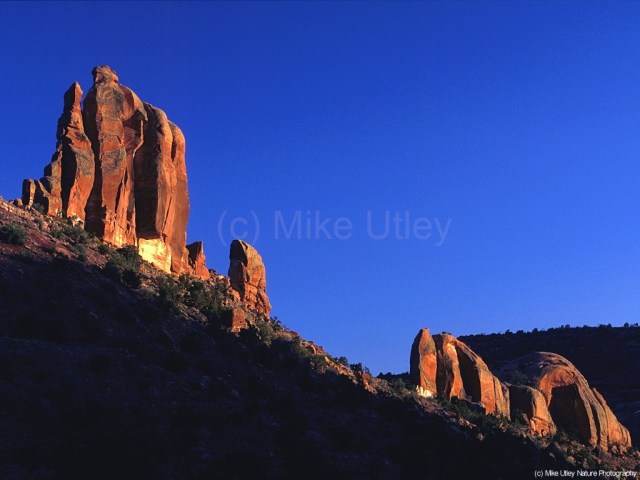
Big Indian Rock, Lisbon Valley, SE Utah (c) Mike Utley
I was raised on a farm about an hour from Lisbon Valley in southeast Utah. It’s an out-of-the-way place of red rock formations and sage-sprinkled canyons used for cattle grazing and open-pit copper mining (and yes, both activities have damaged the land considerably). I photographed this scene one summer evening in the late-1990s as the sun slanted toward the horizon and shadows encroached upon Big Indian Rock (upper left). I was intrigued by the strong diagonal slope my vantage point provided, as well as the bold blocks of color. It was a contrasting scene due to the brightly lit rock formations and the shadows, and because I was using slide film (which has a significantly narrower exposure latitude than negative film), I was unsure if I could render the scene properly exposed and still capture shadow details. The motto for photographers who use slide film is “Expose for the highlights and let the shadows fall where they may.” My goal here was to focus on composition and color, so I decided against using a graduated neutral density filter, which would have created more balance between the highlights and shadows. I thought that allowing the shadows to block-up a bit simplified the image and helped it adhere to my philosophy of quiet contemplation in nature. Busy photographs are chaotic and cause tension, and I sought peace and stillness here, so the fewer distractions, the better. There is still detail in the shadows, but not enough to distract from the tranquil feeling these rocks convey. I like the composition here, with the two rock formations standing near diagonal power-points in the scene against the brilliant blue sky and dark shadows. The rocks glow with the warm tones of the lowering sun and contrast well against the cool blue and black hues. (Canon gear, Fuji Velvia ISO 50)



 Silent Pariah