dusty stew pot her memory lingers by the cold hearth
…..
(#332)
a tiny sun in this cold dark hell golden suisen
…..
(#333)
strings of koto from beyond the bamboo grove my heart breaks again
…..
(#334)
don’t look at me, moon I’m not who you think I am dark night of the soul
…..
(#335)
from my window the mountain; from the mountain eternity
…..
(#336)
green silence and the end of all things sea of trees
(Note: A bit of a title change for this series. I’ve been writing senryu almost as long as haiku and I figured it was time to clarify that these little collections contain both. Haiku pertain to nature and seasons, while senryu address the human condition. The formats are virtually identical; the subject matter differs.)
Pussy Willow Catkin on Twig, near Trout Lake, southwest Colorado (c) Mike Utley
Trout Lake, near the small town of Telluride in southwestern Colorado, is my second-favorite spot on Planet Earth, just behind Heceta Head Lighthouse on the central Oregon Coast. I’ve posted a few images of the lake itself, snugly nestled in the laps of Sheep Mountain, Vermilion Peak, Golden Horn and Pilot Knob amid pine and spruce forests, aspens and a cornucopia of wild flowers. A dirt road circumnavigates the lake, wending its way closer to the peaks and through the woods and bogs. A narrow wooden bridge, which had fallen into disrepair the last time I was there, spans a creek halfway around the lake. It was here, near the collapsed bridge, while photographing elkslip and other wild flowers one summer evening in the late 1990s, that I noticed a lone pussy willow catkin perched on a twig.
I’ve always been enamored with these diminutive delights, tiny and soft and so aptly named (honestly, the term “catkin” is sort of giggle-inducing). There were no willows where I lived on the farm so I’d never had the opportunity to photograph these little guys until now. The light was quickly fading so I set to work. The compositional goal was to isolate the twig and catkin against the background by using a wide aperture setting to blur the background into a solid mass of color in order to make the subject stand out as much as possible. I wanted to express a little story with this image, too, a vignette of the early stages of life, its uphill battle to reach maturity, and the uncertainty that awaits all of us at the end. The catkin was placed on a power-point in the lower left, with the gentle upward arc of the twig leading across the frame to…what? What lies ahead? What of that sudden drop-off at the end of the twig? In life, we may think we have a plan, a goal for the future, but in reality we’re all flying blind. At any moment, our own personal twigs may end abruptly, plummeting us into oblivion. I envisioned the tiny catkin feeling trepidation at the beginning of its journey, leaning back in fear…perhaps steeling itself to perform a Naruto run to the end of the twig and take flight into the unknown. In this brief pause on the cusp of its decision, the air was utterly still, and not a sound came from the forest. Even the ever-present mosquitoes held their collective breaths as they awaited what was coming. I like to think the catkin was preparing itself, screwing up its courage, and calming itself in the cool air and verdant green silence of the woods. And then…
…it’s up to you to decide what happened next. I haven’t returned to this place in years. I hope the catkin’s journey was a happy one, and as brief as this blossom’s lifespan may have been in the grand scheme of things, its ethereal beauty fit right at home in the green silence of the forest, among elkslip, wild irises and columbines. (Canon gear, Fuji Velvia ISO 50)
I’m happy to announce that my poem “A Summer’s Field in Winter” has been published at Chewers & Masticadores. I’m so grateful to Terveen Gill and her team for their support and kindness in publishing my poem. Terveen’s enthusiasm for writing inspires everyone and is such a wonderful catalyst for creativity. I’m both excited and humbled to have my poetry included at Chewers & Masticadores. Thanks so much, Terveen!
“A Summer’s Field in Winter”
“let us sift through summer’s solemn ashes let us scavenge rusted hopes from twisted hulks of yesterdays amid the swelter and the din of frigid silence as crows circle…”
I’d be grateful if you would check out the rest of my poem by clicking this link. Also, be sure to follow and subscribe to Chewers & Masticadores—it’s a wonderful place for those who love writing.
I’m particularly delighted to announce my good friend and fellow writer Diana Wallace Peach has chosen to feature my blog on her Weekend Blog Share at Myths of the Mirror blog. I’m deeply humbled that she chose to showcase my blog this week. Diana is an accomplished writer and poet and her blog is a treasure trove for anyone who loves good writing and amazing story-telling. She’s also one of the kindest, most supportive and encouraging people you could ever hope to meet. Thanks so much, Diana, for this honor. I truly appreciate it, my friend!
You can check out Diana’s Weekend Blog Share post by clicking this link.
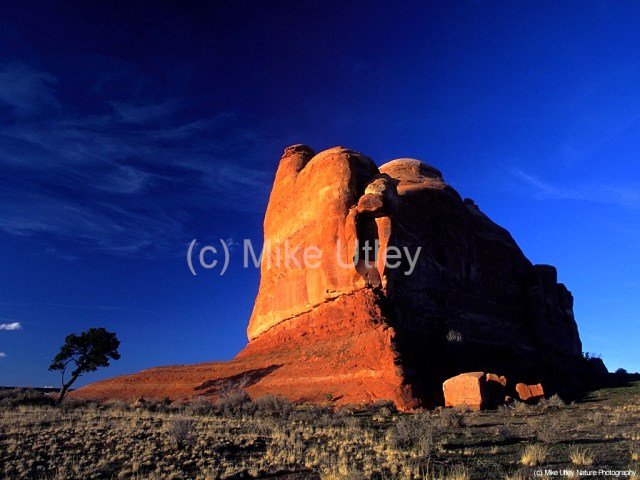
Sandstone Formation & Tree, Lisbon Valley, SE Utah (c) Mike Utley
Lisbon Valley is a relatively nondescript region in southeast Utah near Canyonlands National Park. While its redrock sandstone formations don’t rival the majesty of those found in Canyonlands and Arches National Parks, it has its own hidden marvels, its own unique personality. In the late 1990s, I spotted this rock formation while exploring one late-autumn evening. I was intrigued by several aspects of this scene: the contrasting, opposing oranges and blues; the split-personality of the formation, with half in bright sunset light and the other half in dark shadows; and the looming presence of the formation compared to the diminutive form of the lone juniper tree on the left. And above all, a contemplative stillness. Some might say there’s a David-and-Goliath theme here, a sense of immutable power being challenged by stalwart–if fragile–determination. However, I see something else here…a sense of sorrow, a reaching-out from weakness to strength as the tree casts its shadow on the base of the tower in supplication, as if seeking consolation. A sense of loneliness and isolation. I identify with that juniper tree. I feel deeply that sense of yearning to be a part of something but always finding myself standing on the outside, looking in. Try as it might, the closest that tree will ever come to connecting with that rock is by casting its shadow upon it once a day just before the cold night falls. Such is life in the desert; such is life in this world. (Canon gear, Fuji Velvia ISO 50)
I’m delighted to announce that my poem “Odysseus” has been published at Chewers & Masticadores. I’m so grateful to Terveen Gill and her team for their support and kindness in publishing my poem. Terveen is a writer’s greatest ally and her steadfast encouragement is a bottomless font of inspiration. I’m both honored and humbled to have my poetry included at Chewers & Masticadores. Many thanks, Terveen!
“Odysseus”
“I saw Odysseus sprawled on the sidewalk between The squalid little deli and the boarded-up All-night video place whose weather-stained Posters advertised GIRLS GIRLS GIRLS Amid obtuse indecipherable graffiti and A fallen constellation of multi-hued shards of Broken glass that crunched underfoot like Bone fragments The patina of snow about him Pristine in its absence of footprints from Passers-by…”
I’d be grateful if you would check out the rest of my poem by clicking this link. Also, be sure to follow and subscribe to Chewers & Masticadores—it’s a wonderful place for those who love writing.
Blue Lupine & Water Droplets, SE Utah (c) Mike Utley
There’s nothing quite like a country rain. In the region where I live, summer thunderstorms bring the arid landscape to life as everything seems to shimmer and glow, and the scents of wet sage, pine, juniper, earth and fresh air assault one’s olfactory sense like a heady brew. In this image from the late 1990s, this blue lupine had found refuge beneath a pinyon pine and rode out the storm relatively unscathed, unlike many others that were damaged by the intensity of falling rain and were left standing among tatters of petals. Macro-photography is fascinating, especially when exploring the hidden inner worlds of wild flowers, and this lupine made a perfect subject with its brilliant hues and clinging raindrops. I’m left with the impression of each individual blossom craning skyward, open-mouthed, in an attempt to drink in as much rain as possible. In an area that receives around ten inches of precipitation annually, summer rains are vital for the environment to remain balanced (and also pose the threat of wildfires). The beauty of wild flowers is exquisite and all-too-brief, so capturing these examples of nature’s haiku was a priority for me during my days as a nature photographer. (Canon gear, Fuji Velvia ISO 50)