“Fleabane & Dead Log”

Fleabane & Dead Log, Taylor Mesa, SW Colorado (c) Mike Utley

F43(S)–Fleabane & Dead Log, Taylor Mesa, SW Colorado
I’ve always liked the stark contrast between the small flower and the “eye” of the dead log–sort of a counterpoint of life and death, color and a lack thereof, softness and the dry, almost bone-like texture of the wood. There’s a sense of longing in this photograph, a loneliness, as though the flower is looking skyward in search of hope and compassion, and the “all-seeing eye” is perhaps blind to its supplications for love and mercy. This image was probably my late-mother’s favorite of all of my nature photography. She kept a framed 8×10 of this image on the wall for decades. It brings back a lot of memories. (Canon gear, Fuji Velvia ISO 50)

“Heceta Head Lighthouse”

Heceta Head Lighthouse, Heceta Head State Park, Oregon Coast (c) Mike Utley

W6—Heceta Head Lighthouse, Heceta Head State Park, Oregon Coast
In late March 1995, I took a solo road trip to the Oregon Coast. I’d never done anything remotely similar prior to that, and it was a long drive from my residence in southwest Colorado, but it was Spring Break at the tech school where I was studying and I had the opportunity, as well as a brand new bottom-of-the-line Canon SLR and a 35-80mm f/4.5-5.6 lens. I spent a week along the coast, heading from Coos Bay in the south to Astoria at the northwest tip, and was in awe the entire time. I shot about ten rolls of “typical touristy snapshots,” but this image spoke volumes to me when I had the film developed and viewed the prints for the first time. This is the image that changed my life and set me on a path of pursuing nature photography, something I’d immerse myself in for the next decade or so. This location is my favorite spot on the planet. I was there during a vicious early spring storm system that produced gale-force winds and massive waves most of the week. This image exemplifies the ruggedness and sheer power of the Oregon Coast. I keep coming back to this simple photograph when I need reassurance that there is still beauty in this world, that perhaps hope still exists. This is a transcendent locale for me. I’ve walked the trail to that distant lighthouse and placed my hands on its alabaster skin and gazed out across the endless sea and felt the sun and salt breeze on my face. It’s my heaven, and when I die I hope to have my ashes spread there. It feels like home to me. So, while this image may not evoke or inspire rave reviews, it is the most important image I’ve ever made and resonates deeply within my heart and soul. I wanted to share it with the good folks in this wonderful WordPress community to spread the beauty and hope I found that seminal day at the Oregon Coast. (Canon gear, Kodak Royal Gold 200)

“A Few Haiku (32)”

(c) 2022 by Michael L. Utley

(#187)

the forsaken vase
still stands where you left it
waiting for your flower

…..

(#188)

in the end
my heaven could not redeem
your hell

…..

(#189)

memories of you
litter the oak-shadowed grass
I tread carefully

…..

(#190)

coy spring tarries
just beyond my winter heart
how I yearn for her

…..

(#191)

strawberry spring
the false hope of redemption
as the storm draws nigh

…..

(#192)

my destitute mind
is as barren as my heart
all the words have gone

“Church Rock”

Church Rock, near Lisbon Valley, SE Utah (c) Mike Utley

D49-1(S)–Church Rock, near Lisbon Valley, SE Utah
Church Rock is a unique sandstone formation located a few miles north of Monticello in southeast Utah. It’s a local icon of sorts, readily visible just off the highway. In 1998, I was commissioned by a local museum to photograph old barns in San Juan County, Utah, and Church Rock was on the list. In the 1940s, the land owner used dynamite to hollow-out a section at the base to use for storage for cattle feed. Visible in this image are the remnants of an old corral and a dilapidated windmill to show the scale of the rock formation, which rises 200 feet above the surrounding desert landscape. The weather the day this image was made was windy and the clouds were magnificent and added texture and contrast to the earthy tones of Church Rock. As for its name, the local myth is that in the 1930s a spiritualist and her small cult deemed San Juan County, Utah and Church Rock to be the spiritual center of the universe, and she ordered the complete hollowing-out of Church Rock to serve as her church. The 16’x24′ hollow section was thought to be proof of this but was proven false. (Canon gear, Fuji Velvia ISO 50)

“Grand Tetons & Snake River at Sunrise”

Grand Tetons & Snake River at Sunrise, Grand Teton National Park, Wyoming (c) Mike Utley

In August 1996, I took a trip up north to see my buddy Jeff in Montana. During that trip, I visited several national parks and monuments in Montana, Wyoming and South Dakota, including Glacier, Yellowstone and Grand Teton National Parks, Mount Rushmore National Memorial, and Devils Tower National Monument. On my way home, I spent two nights at Schwabacher Landing in Grand Teton National Park sleeping upright behind the steering wheel of my little truck in bear country (no tents allowed) and woke up both mornings to this very sight. Shortly after making this image, a bald eagle flew lazily across the sky, then three moose decided to stand right smack in the middle of the river for about an hour, watching me. Later that day at another Grand Teton location I saw a black bear. It was incredible. Sometimes nature can be wonderfully generous. (Canon gear, Fuji Velvia ISO 50)

“Indian Paintbrush & Bluebird Feather”

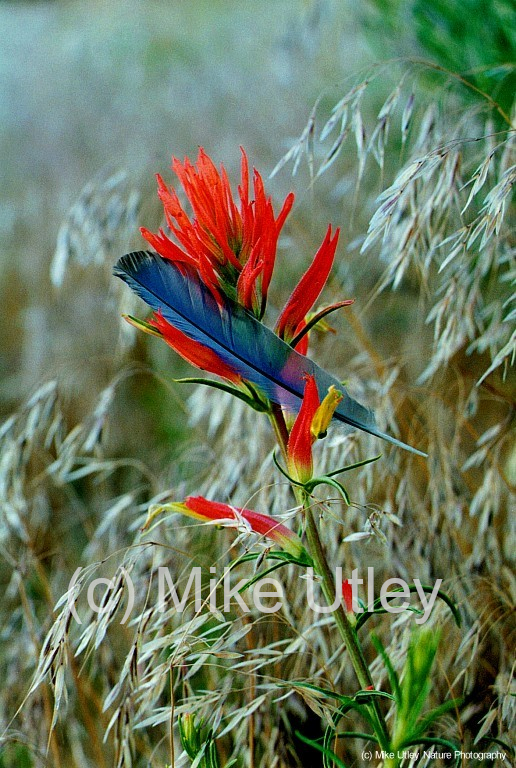
Indian Paintbrush & Bluebird Feather, SE Utah (c) Mike Utley

F25–Indian Paintbrush & Bluebird Feather, SE Utah
I came across this Indian paintbrush one late-summer afternoon at the farm. It was surrounded by dry cheatgrass, and a long-dead pinyon pine stood nearby. At the base of the flower were several bluebird feathers, the remnants of a recent meal left by some small predator (perhaps one of the farm cats). Immediately, I was struck by the three primary colors–red, yellow, blue–and how the neutral tones of the cheatgrass provided the perfect background to amplify the colors. I rarely ever manipulate a scene (aside from perhaps clearing away dead sticks or debris to unclutter an image), but this image demanded a bit of artistic license, so I placed a feather in the flower and was pleased with the resultant image. (Canon gear, Kodak Royal Gold 100)

“Breakers on Rocks”

Breakers on Rocks, near Port Orford, Oregon Coast (c) Mike Utley

W17(S)–Breakers on Rocks, near Port Orford, Oregon Coast
I spent the morning photographing breakers crashing like cannon-shots onto huge boulders just off the coast south of Port Orford in southern Oregon. These booms were incredibly loud. During a lull in the action as I was examining tiny fossilized shells in a nearby boulder, I glanced back at the ocean and saw the water rising rapidly. The Oregon Coast is notorious for its sneaker waves, which are like mini-tsunamis. I had climbed down a ten-foot dirt embankment to get to the vantage point for this image, and suddenly I realized I had to scramble back up immediately. Luckily, I was able to find some rocks to climb up and made my way to safety. When I looked again at the water, it had completely overwhelmed the spot I’d been standing on seconds earlier. I learned a valuable lesson that day: never turn your back on the ocean at any time, for any reason. (Canon gear, Fuji Velvia ISO 50)

“Boulder, Cliff & Moon”

Boulder, Cliff & Moon, Lisbon Valley, SE Utah (c) Mike Utley

D35-1(S)—Boulder, Cliff & Moon, Lisbon Valley, SE Utah
Lisbon Valley is a rather nondescript area in southeastern Utah devoid of the arches and spectacular rock formations found in nearby Arches and Canyonlands National Parks, but I’ve made a few nice images there. I loved the simplicity of this “intimate landscape” of boulder, cliff and moon. The rocks glowed brilliantly in the westering late-evening sun (no color manipulation here), and the darkened sky contrasts starkly with the fiery orange tones. The moon was rendered tiny by the 24mm wide-angle lens I used, which exaggerates the distance between objects in the foreground and background. I’ve always found the surface details of red rock sandstone fascinating, and that’s what I was attempting to convey here. This is a favorite image of mine due to the colors, surface details, lines, forms and overall contemplative tone. (Canon gear, Fuji Velvia ISO 50)

“Sheep Mountain & Wild Flowers”

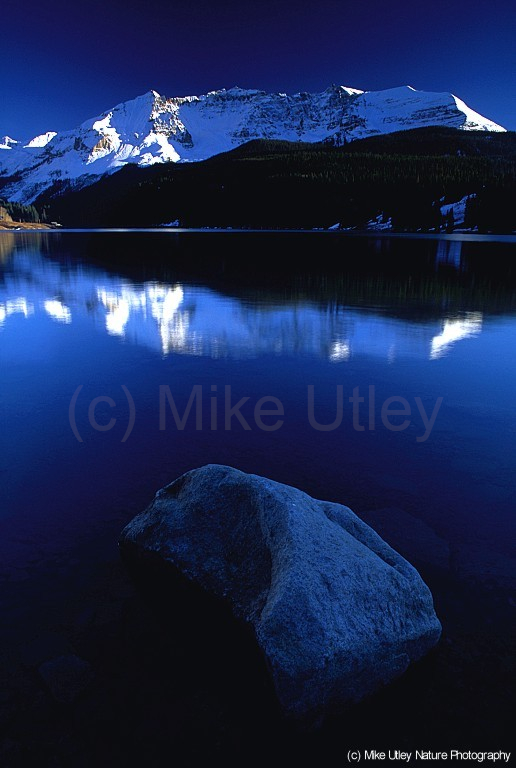
Sheep Mountain & Wild Flowers, near Trout Lake, SW Colorado (c) Mike Utley

M10-1(S)—Sheep Mountain & Wild Flowers, near Trout Lake, SW Colorado
Sheep Mountain is located near Trout Lake, about ten miles from the small tourist town of Telluride in southwest Colorado. This image was made a couple of miles from the lake one summer evening. Due to the contrast in lighting between the sunlit mountain and the open shade of the meadow and distant forest, a soft-edged two-stop graduated neutral density filter was used to balance the exposure of the scene. This image was made before digital photography became mainstream, so all technical effects had to be made in-camera at the time of exposure without having any way to review the final image until the slides arrived in the mail later. Digital photography makes exposure-balancing effects such as this much easier with post-processing tools such as HDR (High Dynamic Range), which can balance the lighting in a scene by combining multiple exposures of the same subject. When this image was made in 1995, photographers had to know how to do all the tricks in-camera before pressing the shutter button. (Canon gear, Fuji Velvia ISO 50)

“A Few Haiku (31)”

(c) 2022 by Michael L. Utley

(#181)

three chickadees…
winter’s ellipsis as earth
pauses in thought

…..

(#182)

winter cattails
frozen tiki torches glow
in silver moon-fire

…..

(#183)

in night’s cold silence
old snow-laden branch succumbs
too many winters

…..

(#184)

warmth and light and love
all the world’s hope resides
in my glowing hearth

…..

(#185)

messenger moon
conveys hope to my lost love
through the years and tears

…..

(#186)

light in the darkness
dawn of hope or setting sun
I cannot decide