I’m delighted to announce that my poem “Odysseus” has been published at Chewers & Masticadores. I’m so grateful to Terveen Gill and her team for their support and kindness in publishing my poem. Terveen is a writer’s greatest ally and her steadfast encouragement is a bottomless font of inspiration. I’m both honored and humbled to have my poetry included at Chewers & Masticadores. Many thanks, Terveen!
“Odysseus”
“I saw Odysseus sprawled on the sidewalk between The squalid little deli and the boarded-up All-night video place whose weather-stained Posters advertised GIRLS GIRLS GIRLS Amid obtuse indecipherable graffiti and A fallen constellation of multi-hued shards of Broken glass that crunched underfoot like Bone fragments The patina of snow about him Pristine in its absence of footprints from Passers-by…”
I’d be grateful if you would check out the rest of my poem by clicking this link. Also, be sure to follow and subscribe to Chewers & Masticadores—it’s a wonderful place for those who love writing.
Blue Lupine & Water Droplets, SE Utah (c) Mike Utley
There’s nothing quite like a country rain. In the region where I live, summer thunderstorms bring the arid landscape to life as everything seems to shimmer and glow, and the scents of wet sage, pine, juniper, earth and fresh air assault one’s olfactory sense like a heady brew. In this image from the late 1990s, this blue lupine had found refuge beneath a pinyon pine and rode out the storm relatively unscathed, unlike many others that were damaged by the intensity of falling rain and were left standing among tatters of petals. Macro-photography is fascinating, especially when exploring the hidden inner worlds of wild flowers, and this lupine made a perfect subject with its brilliant hues and clinging raindrops. I’m left with the impression of each individual blossom craning skyward, open-mouthed, in an attempt to drink in as much rain as possible. In an area that receives around ten inches of precipitation annually, summer rains are vital for the environment to remain balanced (and also pose the threat of wildfires). The beauty of wild flowers is exquisite and all-too-brief, so capturing these examples of nature’s haiku was a priority for me during my days as a nature photographer. (Canon gear, Fuji Velvia ISO 50)
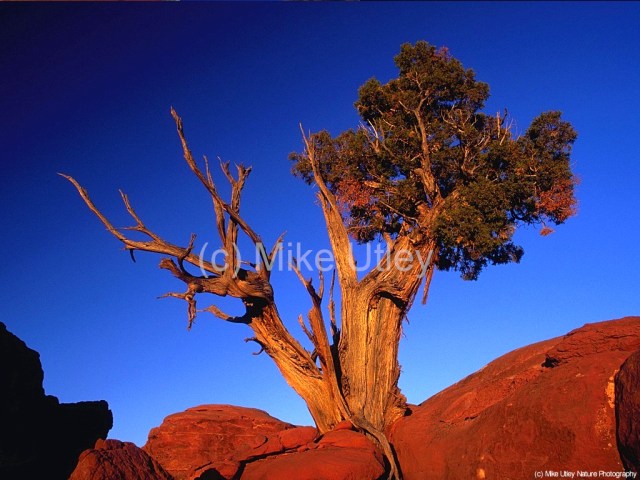
Juniper Tree on Rocks, near Canyonlands National Park, SE Utah (c) Mike Utley
I’ve always found something jarring and surreal about desert landscapes, and even more so with regards to intimate desert portraits such as this half-dead juniper tree growing among sandstone boulders. In such a sere, austere environment, life somehow not only manages to exist, but to persist against all odds. I came upon this scene in 1996 while exploring near Canyonlands National Park in southeast Utah one late-summer afternoon. I was struck by the sheer audacity of the stunted, crippled juniper as it clung tenaciously to the sandstone, its roots delving between cracks, seeking the sand below in hopes of the promise of moisture. It’s a common tableau in the desert. What lives there has earned the right to survive through adaptation and sheer luck.
I think what really stands out, however, is a sort of duality present in this scene: the split personality of the tree as one half thrives and the other diminishes; the limited color palette of orange-brown and graduated blue –opposing hues on the color wheel; and the curious negative space at the bottom left corner provided by a rocky protrusion in complete shadow. It appears as though someone has torn the corner off the image, creating an odd sense of mystery, and serves to almost throw the image off-balance—a black nothingness to contrast with the vital, living essence of the tree.
From a technical standpoint, it was a simple shot. I used a 24mm f/2.8 wide-angle lens to frame the image, and a polarizer filter to eliminate glare on the sandstone and juniper leaves, which also enhanced the natural color gradation in the sky.
This image is among my favorite desert photos. It doesn’t hold the majestic grandeur of a sprawling vista, and it’s rather prosaic in nature (it’s a tree on a rock), but it speaks to me of contrasts and opposites, a subconscious pulling and pushing, and an enigmatic, contemplative stillness, a recurring theme in my nature photography. (Canon gear, Fuji Velvia ISO 50)


 Silent Pariah