I stood at the end of the earth As it trembled and moaned Beneath me The great dark monstrous Pacific Infinite and unseen Before me Mindless Inexorable The cliffs below me besieged By the stentorian onslaught of Night-cloaked sea
A lifetime of fear has deafened me I cannot hear it It does not exist
I stood at the end of the earth As it shuddered and groaned Beneath me The obsidian veil of the void Stretched taut above me A canopy of moonless ubiquity A spray of crystals muted by An eternity of Distance and time
A lifetime of sorrow has blinded me I cannot see it It does not exist
I stood at the end of the earth As it writhed and spun Beneath me The virginal rays of an Ancient sun gilding all The soaring albatross The breaching whale The crying gull The gamboling dolphin
A lifetime of hubris has dulled my mind I do not know these things They do not exist
I stood at the end of the earth As I sought to uncover The great mystery The answer is all around me Everywhere And forever out of reach
Raspy sigh of too many cigarettes Grease-blackened claw points in the general direction of Eternity Stench of gasoline and sweat Indecipherable name emblazoned on Filthy coveralls Gas pump chugs and stutters Connected to my car by an umbilical cord of Ancient dinosaurs His eyes lost in pools of wrinkles and regrets As my eyes follow his finger Nothing but rock and sand and the howls of The lost In this desolation
Road and horizon merge in a Fitful seizure of mirage The heat a coda to all things here Dull and dusty sage and creosote bushes A wretched effigy of life In this hardscrabble wasteland Not real Not real at all Nothing lives here Nothing can live here Nothing at all
That road don’t go nowhere mister
In the distance A phantom zephyr on the highway A sinuous dust devil Snakes from earth to chrome-hued sky This eldritch thing It dances and writhes and bespeaks of Ancient knowledge An augur of blind terror In the breakdown lane Of this faded ribbon of Cracked and sticky asphalt
It can’t get me here My mind whispers Here in this run-down LAST GAS FOR 255 MILES sanctuary This final outpost of sanity Sun-bleached boards and Rusted gas pumps Stand sentinel against What lies beyond Against what should not be But is anyway
That road don’t go nowhere mister
The gas pump rattles to a stop His trembling hands disconnect the hose In post-coital silence Hi-test fumes cloying in the Furnace heat The old man takes my money
The world has stopped on it axis The day is perfectly still There is no sound There is only the sterile heat Of the desert And the blackness of what is to come
He grabs my shoulder through the car window His ancient hand a talon digging deep His pleading eyes rheumy and weeping He swallows His Adam’s apple bouncing in his Grimy neck
That road don’t go nowhere mister
There is lunacy in his weeping eyes And there is truth And I smile at him And something passes between The two of us A last vestige of humanity Before the coming storm I glance in my rear-view mirror There is nothing behind me There is everything behind me There is no going back
I swallow a knot of panic I look at the man This road doesn’t go anywhere I say But it’s the only road there is
And I pull away from the station The old man a scarecrow in the mirror Arms akimbo Sweat-stained cap askew on his head And then he is gone Devoured by the nothingness behind me
There is no air Down there Down in the dark Where I choke On my life Nature abhors A vacuum But rage Thrives Therein
Emptied Gutted A carcass Rotting Under a red Alien sun Gasping a mere Reflex I am a fish Cast upon the shore Drowning on nothing Dried eyes Blind Bulging I see nothing So nothing exists The calm susurrus of the waves Is the great deception I cannot reach The water I am not fit for the Fisherman’s net The cry of the gull The sigh of sea grass in the breeze The languid flap of my tail The hard hot stones of the beach The stench of all things The sea
I did this A handful of fear and feathers The black eye of God Dulling Fading Misting Silent A handful of blood and feathers I did this
A tiny universe Gasping for breath Grasping for death Stopped cold By the golden orb of fate
I have seen myself In the black eye of God The dulling Fading Misting Silent Eye of God And there I stood An empty eternity Before me My marbled form Rigid My ivory eyes Blind Yet full of knowledge A handful of bones and feathers I did this
I cried As the sparrow died In my hand Its blood a tracery In my palm A crimson filigree My life line stained In its death I cursed myself Railed at the sky At the earth At all things Why
There is no why There only is And this was bitter
The dead bird Was still warm When I buried it
A handful of nothing A heart crushed by everything I did this
I vomit out myself again each night When lights go out and tired thoughts awake To find that darkened mere from which to slake Their thirst for dark dominion. In the bright And sane pedantic musings of the light Where every thought, word, deed presumes to take On tones of gilded gravity, I stake My soul against the coming evening’s fight.
The day is done; I’m with my thoughts, alone And sleep cannot—will not—this night prevail. My mind, a dynamo, begins to race And images appear as if they’ve grown In some dark, dank and fetid fen. I quail As my true self confronts me, face to face.
I see myself most clearly in the dark When eyes stare listlessly into the gloom Of my unlighted silent little room And clarity has never missed its mark. The diff’rence between day and night is stark, Where shadows rob the flower of its bloom And night-noise bespeaks harbingers of doom Who from abyssal shores will soon embark.
There is no madness here; there is a shift Of light to darkness only, but in fine It colors every thought a darker hue And ushers in a sort of seismic rift That sullies every fruit on every vine And every thought and every feeling, too.
The day’s lucidity reduced to lies, I gaze at the abyss and there I see On some far distant shore another me Whose own lucidity is in demise. The shadows—living things amid the cries And cruel cacophony of things that flee The light—surround me as if to decree To all assembled, “This is where hope dies.
“What’s done in daylight holds no power here. We’ll strip the varnish from your petty dreams And rid you of your sanity anon. For daylight is a poor façade for fear And reason ineffectual when screams Will render moot the light you count upon.”
And once again, like every other night The battle lines are drawn upon the sands Of sleep not yet attained, and on these lands Depression pits the dark against the light. And once again, like every other fight I fall upon the ground, the shadows’ hands Upon my throat in icy burning bands, All thoughts of hope now fading out of sight.
And then from distant shores of the abyss Across the chasm, lilting in the dark A plaintive, calming voice, a gentle weep Touches my mind, my soul, as if a kiss Were sent to me upon a winging lark: “Seek sleep,” it says to me, “let go, seek sleep.”
And I give in and in surrendering I leave behind the darkness and the din Of shadowlands where battles rage therein And naught is won or lost. And that’s the thing That catches in my mind just like the ring Of distant bells, discordant in their thin Attempt to quell the heart surfeit of sin In any man whose sleep the night won’t bring.
And leaves unanswered still my current plight: Is truth found in the darkness or the light?
Recently, I read of a study by Johns Hopkins University concerning the relationship between hearing loss and dementia. According to the study, people with mild hearing loss were twice as likely to experience dementia, those with a moderate loss were three times as inclined, and those with severe hearing loss were five times more prone to develop cognitive issues that fall under the umbrella of dementia. Contributing factors include accelerated atrophy of brain tissue caused by hearing loss as well as the profoundly negative effects of social isolation many deaf people face.
I was vaguely aware of this, having read something about it in the past, but I was not prepared for the statistics this study presented. So, of course, my overly analytical mind seized onto this like a Chihuahua with a squeaky toy and wouldn’t let go. You see, dementia is one of my greatest fears, and I have the dubious honor of hitting the Dementia Trifecta: I have severe hearing loss, major depression and severe chronic insomnia, all three of which are precursors to some form of dementia. Add to this the fact that dementia runs on both sides of my family and you have a nightmare scenario in the making.
I’ve battled major depression for as long as I can remember, dating back to early childhood. Much of this originated due to the severely dysfunctional family in which I was raised. My depression has been, for the most part, resistant to treatment. There’s a brain chemistry component involved, of course, but I’ve never found an anti-depressant that actually did anything to lessen the effects of my depression. Talk therapy helps to a degree, but at one hour every two weeks, it’s not something that has a lot of carry-over during the interim between sessions. PTSD has an effect on my depression as well, and has contributed to the futility I’ve experienced with regards to my inability to make any significant progress in treating my depression. EMDR therapy caused a disturbing negative reaction which left me experiencing several strange physical symptoms, some of which are still present as of this writing.
My sleep disorder has been traced back to one particular incident involving domestic violence when I was eleven years old. It forced me to become hyper-vigilant at an early age and I ended up “training” myself to stay awake until my father went to bed and was asleep. Only then could I know my mother was safe, and only then could I allow myself to try to sleep. However, years of this hyper-vigilance produced insomnia so intense and pervasive that I still suffer from it decades later. Nothing—absolutely nothing—has ever put a dent in my insomnia, and after years of therapy and every treatment method I could find, I finally surrendered to it and accepted that it was not going to go away. And it hasn’t. And its effect on my life is profound.
Of course, the reason I began this blog is because I’m deaf. Hearing loss has such an over-arching impact on one’s life. Those of you reading this who are deaf will understand; those of you who are not cannot understand unless you have a close family member or friend who experiences deafness. Even then, it’s not quite the same as being deaf, but it does offer a uniquely intimate window into the deaf experience.
Deafness is all-encompassing. Everything is affected by it to one degree or another. Everyone knows, for example, that a deaf person has difficulty or a complete inability to enjoy music, but how many hearing people know that hearing loss can affect the way a deaf person walks? Or that it is a possible precursor to the horror of dementia? How many hearing people know that deafness-induced social isolation can lead to issues such as poor eating, addiction, failing physical health due to lack of exercise and self-care, depression, and even heart disease? There’s much more going on here, much more at stake for those who are deaf, than meets the eye (or the ear, as it were).
In my own unique case, there appears to be a nasty synergy occurring among my Big Three Issues: deafness, depression and insomnia. When one gets worse, the others follow suit, thus creating the proverbial “vicious cycle,” and can lead to a snowball effect. When I can’t sleep, my depression worsens, which affects my sleep to a greater degree, which causes my depression to plummet even more, which causes my hearing to suffer from both fatigue and an inability to concentrate deeply enough to lip-read. Also, when I’m lacking sleep, my ears ring much more loudly and incessantly and it actually feels as though my inner ears are feverish. When my remaining hearing suffers like this, it makes my depression worse, and it becomes a situation where it feels as though I’m spiraling downward, caught in some uncanny and surreal maelstrom. When this occurs, the only remedy is sleep, and lots of it. Which, of course, is difficult for me to attain.
What does this have to do with dementia? And am I guaranteed to slip into the darkness of that terrible state of being? I suppose I should explain why this concerns me so much.
My grandmother on my father’s side developed dementia in her ’80s. One of my father’s older sisters followed suit and became so violent that she actually would shoot at people. My father eventually fell into that very same black hole, which ultimately led him to take his own life at age 76. During one of my last interactions with him, in 2015, he was in a paranoid rage, completely out of his mind, and he punched me and threatened to shoot me. I had to file a police report for physical assault. He lied to the police about what happened and they couldn’t charge him because there were no other witnesses. I saw him only twice shortly after that. By the time he killed himself, he was completely in the throes of dementia.
But that’s not really why I’m so concerned. The main reason for my fears of falling prey to this insidious disease has to do with my grandfather on my mother’s side.
I recently posted a trilogy of poems I penned about my grampa, alluding to his descent into dementia. I wrote these pieces out of feelings of both sadness and guilt. Sadness because of never getting to know him as well as I would have liked, and guilt for not being able to force myself to visit him in the nursing home after a series of strokes decimated him and then the indignity of Alzheimer’s Disease settled over him like a filthy cloak, forever obliterating what was left of my grampa.
He was in the hospital after one of his early strokes. My mom, my two sisters and I went to town to visit him. There he was, my big Viking grampa (half-Danish, half-Norwegian), broad shoulders and even broader ever-present grin, sitting on the edge of his hospital bed. He looked normal, seemed happy, appeared fully lucid. My mom was chatting with him and he was smiling as always…and there it was…a facial tic on his right cheek. He didn’t notice it. He continued smiling as my mom talked, and the tic continued for several moments, worsening, twisting my grandfather’s face into something almost obscene. He couldn’t tell what was happening to him, he just sat there on the bed, twitching. I felt the blood leave my head and everything became quiet and I felt my gorge begin to rise and I turned and fled the hospital and ran out to the car, horrified at what I’d just seen. Was that my grandfather in there? Was it really him? It couldn’t have been. The man I’d known all my life could never look like that man I’d seen sitting on the edge of the hospital bed with his face twitching.
It took several minutes for my stomach to settle. Later, my mom and sisters came out to the car and we left for the farm. And that was the last time I ever saw my grampa alive.
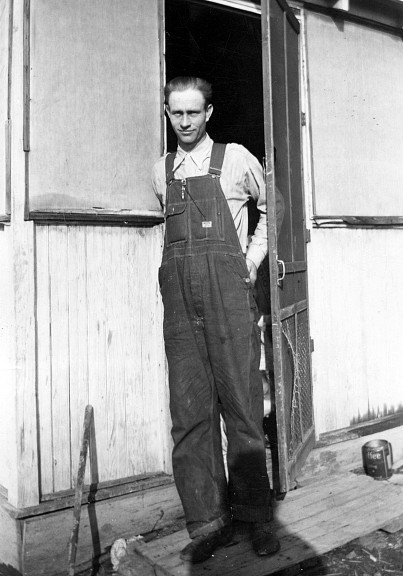
Something had broken inside me. I wasn’t sure what it was. Perhaps a good chunk of my innocence had been shattered beyond repair. Whatever it was, I couldn’t bring myself to visit my grampa after that. Every time my mom would drive to town to see him, either in the hospital, or later in the nursing home, I stayed home. I just. Couldn’t. Do. It. The mental image of my grandfather sitting in that hospital room twitching was burned into my mind and all I could do was try to bury it. So, I went to work doing just that, grabbing my shovel and piling tons of guilt on top of it until I was numb. I mean, that wasn’t my grandfather. Not anymore. My grandfather was the guy who always wore bib-overalls and smelled of coffee and cigarettes. My grandfather was the guy who played the accordion and sang Norwegian songs to us, his big grin so expressive and his blue eyes twinkling. He was the guy whose idea of a cup of coffee was about an inch of coffee and the rest a mixture of honey and condensed milk (so sweet you couldn’t even taste the coffee). He was the guy who talked about fishing all the time and made homemade sinkers in his work shed where he also kept his fishing worm farm. He was the guy who taught me to drive in his old black 1949 Dodge truck, double-pump clutch and all. He was the guy who always had a prank to pull, a laugh to bellow, a grin to share. He was the best guy who ever lived. No, that man in the hospital—and later in the nursing home—was not my grandfather. He was an imposter, some thief who had stolen my grampa’s body for his own and had twisted it out of shape and scared the living daylights out of his teenaged grandson.
My grampa died when I was 21. That was the first time I saw him since that horrible day in the hospital years before. He looked peaceful in his casket. He’d lost a lot of weight and was gaunt, but that was him, that was my grampa. That eldritch imposter had finally returned my grandfather’s body to its rightful owner, and we were burying him. It was hard to look at him, but I did. I had to make sure.
I carried around this guilt for years. I loved my grampa dearly, but I had betrayed him. I had left him when he was the most vulnerable, and I hated myself for it. But what could I do? He was gone now and there was no way to tearfully apologize to him for having abandoned him. Toward the very end, he didn’t recognize anyone, so if I’d gone to see him he wouldn’t have known who I was anyway, I told myself in an attempt to quiet that guilt. But guilt is a funny thing. When it gets to yammering, nothing will shut it up.
Well, almost nothing.
In 2012, after having experienced a 20-year fallow period in my writing, I suddenly sat down one night at my computer and began writing again. Poetry this time, unlike in the past when I’d focused on short fiction, back when I was actively submitting my work to publishers and racking up rejection slips. That night was apparently the night my long-absent muse shat on me. For the next month or so, I wrote poetry, piece after piece, and among those pieces were three poems about my grandfather. It was time. Time to deal with years of guilt with regards to the Greatest Grampa Who Ever Lived. The words flowed like tears I’d long-needed to cry but never had been able to. I realized I’d finally found a way to deal with the guilt I’d carried for so long. It hurt, but I was able to honor my grandfather in writing, and it helped more than I could ever have imagined. I recall reading those three poems with my vision blurred with tears from all the memories they evoked. I remembered my old Super-8 film of my grampa smiling and talking to me—silent film, all five seconds of it—and it struck me that he was still there and always would be, no matter where I was or what I was experiencing in my life. All I had to do is close my eyes and remember.
Dementia took my grandfather away. The world is a lesser place without him. And if dementia could fell my grampa, it could take down anyone, including me. And so I worry. I worry that I may suffer the same fate as my grandfather, a fate no one should have to endure, a fate that robbed him of his very essence and robbed the rest of us of the most wonderful man imaginable.
I understand that it’s not a done deal. There’s no guarantee it will happen to me. It skipped my mom, who was lucid and still herself until the end at age 75. But I keep my eyes open for any early signs just in case. I know mine isn’t the only family that has battled this monster. My love goes out to of all those who have gone through this. It’s painful, and the guilt can be crushing, but we will remember those loved ones as they were, and we can honor them in our own unique ways.
The kid was too young This distant uncanny boy Face absconded Into the murky depths of his Drenched and threadbare Crimson hoodie Eyes mere pinpricks Of sentience in the shadows Where his face should be On this pouring midnight Sidewalk where even the rain seemed Exhausted in the scornful cones Of streetlamp illumination And unseen clouds sighed above Too tired for the bluster and pretense Of thunder And he sat there in this mess of a night On a bench where no bus would ever stop For anyone at anytime for any reason Staring into the distance at both Something and nothing at once Moveless save for an occasional shiver Waiting for someone or something Or perhaps nothing at all
His shoes were soaking wet Those black hi-tops iridescent From rain and gutter filth His dark spidery fingers Loomed together in some Cryptic pattern on his lap Where rainwater pooled and eddied before Dispersing first through his skinny legs Then between the filthy slats of the bench To merge with the noisy gutter rill And then with the sewage below And then the poisonous river And then the darkness of the ocean Of some other universe
And I passed him in the rain Of that eternal night as I made My own way into my own darkness And I thought of some worried mother Sitting at some rickety kitchen table Bathed in the sickly yellow glow of a naked Tungsten bulb Haunted eyes fixed somewhere Beyond the weeping window panes Hands wringing in some unconscious Talismanic effort of projected protection For some lost child some prodigal son Out there alone in the rain And I couldn’t decide if she was The boy’s mother Or my own
And then my blackness Was interrupted by a voice Behind me Not that of a man Yet not that of a child And I stopped and turned And the kid was there And in his outstretched hands He held a soaked and faded Red hoodie and a pair of Sopping black hi-tops And his eyes were calm And his face shone in the rain And he didn’t say a word He just pointed at my own Bare feet and my freezing body And then he was gone His own bare footprints Lingering momentarily on the sidewalk Before the rain took them away
I saw Odysseus sprawled on the sidewalk between The squalid little deli and the boarded-up All-night video place whose weather-stained Posters advertised GIRLS GIRLS GIRLS Amid obtuse indecipherable graffiti and A fallen constellation of multi-hued shards of Broken glass that crunched underfoot like Bone fragments The patina of snow about him Pristine in its absence of footprints from Passers-by as if the stench of his Existence had formed an unseen barrier A half-moon DMZ buffering His world from ours And ours from his And seemed to accelerate those who passed As if sling-shotting them along their snowy Midnight trajectories by means of his own Anomalous gravity And he was invisible This shivering, coughing Odysseus This Odysseus of ancient rheumy eyes and Filth-caked garb of indeterminate color and Dirty twitching fingers destroyed by age and arthritis That latched onto Nothingness in the inhuman chill Of this strange distant land Far from home
I saw Odysseus standing on the corner Across from the new shopping mall with Hundreds of stores and a garish GRAND OPENING FREE HOT DOGS WIN A NEW TOYOTA TRUCK Sign filling up half the blazing summer sky The color of which no one noticed as they Funneled mindlessly into the parking lot of sticky asphalt Eager to rid themselves of their wealth Like lemmings compelled by the inexorable call Of the briny deep This sun-stroked Odysseus’ sign Garnered far less attention WILL WORK FOR FOOD And like some weird contrary magnetism it Served only to avert the eyes of eager shoppers Whose cash-bulging wallets held no alms This day or any other day for anyone With the temerity the gall the nerve To spoil the festive mood of capitalism And he was invisible This gaunt, silent Odysseus This Odysseus of haunted eyes the shade of Tortured youth and abandonment An aura about him that described an intimate ken Of the black brackish hearts of fathers Who show their children love by means of The belt the closed fist the bruise the shattered bone His outstretched hand unseen, voided In the swelter and exhaust fumes Of this strange distant land Far from home
I saw Odysseus posed beneath the arc-sodium glare Of streetlights in stilettos and not much else As vehicles prowled the night like hungry panthers Purring as they edged up to the curb to test their prey Whose prayers, if any, went unanswered day by day Whose god was the black tar of forgetfulness Purchased nightly with the currency of her body And she leaned hesitantly into the maw of the predator A deal done through open-windowed anonymity Then undone moments later amid an avalanche Of raucous laughter and filthy epithets As the panther sprang from the curb in search of other prey Stranding her alone in the antiseptic wash Of the indifferent streetlights that left her feeling All the more dirty And she was invisible This trembling, empty Odysseus This Odysseus of painted eyes the shame of which No amount of camouflage could veil The craving in her veins an all-out roar Obliterating everything Tears gone eons ago Fear driving her like some twisted dynamo Toward the blackness of the next fix Or the grave In this strange distant land Far from home
I saw Odysseus supinated on the center stripe Of a dark desert highway Leather-gloved hands folded neatly on leather-clad breast As four cops stood chatting idly above him like distracted pallbearers His motorcycle a hundred feet away in a thousand pieces His helmet still attached and useless As the shield of a fallen warrior A mere formality at this point The silent ambulance en route with idiot lights flashing To scoop this thing off the road and deposit it Somewhere else And he was invisible This stilled, hushed Odysseus This Odysseus of black leather and broken body Who would soon cease to be a nuisance to the cops And become a nuisance to the coroner And then to the earth itself And then forgotten Just some meaningless blip on the back page Of the next day’s paper where the anonymous Go to die In this strange distant land Far from home
I have seen Odysseus at the hospital stitched with tubes A human loom I have seen Odysseus in the dim hallways of high school Eyes glued to the floor in a gauntlet of cat-calls I have seen Odysseus unconscious in the shade of an oak in the city park Reeking of cheap booze and excrement I have seen Odysseus on dusty shoulders of forgotten highways Faded signs in hand that say Albuquerque or Denver or Phoenix I have seen Odysseus in the bleachers of baseball games On county road crews in supermarkets in churches In unemployment lines in bars in prisons In the mirror
Everywhere I look he is there Trying to find his way back
Father said I have seen you in my dreams My alabaster boy My pristine son Marked neither with scar nor blemish The innocence of childhood aglow Upon your brow like the light of A thousand suns Your mind untouched By fear and the lies of men Your future the color of Quicksilver and autumn wheat
Father said And so I must put my mark upon you For it is my right as your father To shape you in my image To lay a path before you From which you must never stray Thus sealing your destiny in the book of life According to my will
Father said For because I am of lowly station I shall make you ashamed of your station For because I am uneducated I shall make you ignorant of vital truths For why should you, my son Benefit from an enlightened mind When I have not
Father said For because I am selfish I shall make you want For because I am angry I shall make you timid For why should you, my son Benefit from the ability to love yourself When I have not
Father said For because I am unstable I shall make you distrustful For because I am violent I shall make you afraid For why should you, my son Benefit from a happy childhood When I have not
Father said For because I am controlling I shall make you powerless For because I am abusive I shall make you hate yourself For why should you, my son Benefit from healthy relationships When I have not
Father said For you are mine And I control all things And you will never be free Of me For why should you, my son Benefit from a loving father When I have not
Father said I have seen you in my dreams My alabaster boy My pristine son Therefore you shall have none And I will be there with you Until the end of your days For why should you, my son Benefit from life When I have not