Blue Lupine & Water Droplets, SE Utah (c) Mike Utley
There’s nothing quite like a country rain. In the region where I live, summer thunderstorms bring the arid landscape to life as everything seems to shimmer and glow, and the scents of wet sage, pine, juniper, earth and fresh air assault one’s olfactory sense like a heady brew. In this image from the late 1990s, this blue lupine had found refuge beneath a pinyon pine and rode out the storm relatively unscathed, unlike many others that were damaged by the intensity of falling rain and were left standing among tatters of petals. Macro-photography is fascinating, especially when exploring the hidden inner worlds of wild flowers, and this lupine made a perfect subject with its brilliant hues and clinging raindrops. I’m left with the impression of each individual blossom craning skyward, open-mouthed, in an attempt to drink in as much rain as possible. In an area that receives around ten inches of precipitation annually, summer rains are vital for the environment to remain balanced (and also pose the threat of wildfires). The beauty of wild flowers is exquisite and all-too-brief, so capturing these examples of nature’s haiku was a priority for me during my days as a nature photographer. (Canon gear, Fuji Velvia ISO 50)
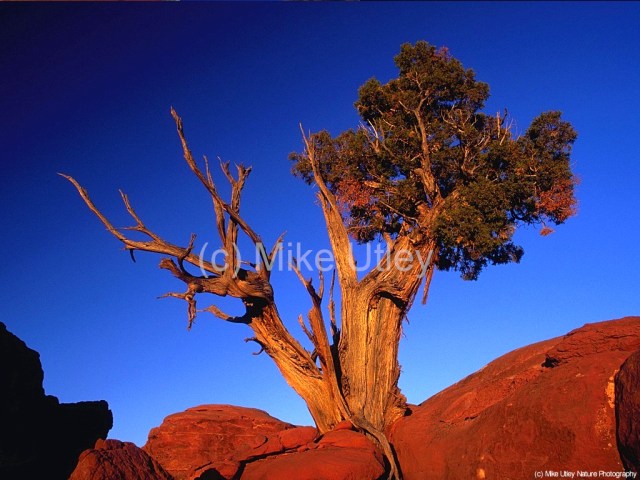
Juniper Tree on Rocks, near Canyonlands National Park, SE Utah (c) Mike Utley
I’ve always found something jarring and surreal about desert landscapes, and even more so with regards to intimate desert portraits such as this half-dead juniper tree growing among sandstone boulders. In such a sere, austere environment, life somehow not only manages to exist, but to persist against all odds. I came upon this scene in 1996 while exploring near Canyonlands National Park in southeast Utah one late-summer afternoon. I was struck by the sheer audacity of the stunted, crippled juniper as it clung tenaciously to the sandstone, its roots delving between cracks, seeking the sand below in hopes of the promise of moisture. It’s a common tableau in the desert. What lives there has earned the right to survive through adaptation and sheer luck.
I think what really stands out, however, is a sort of duality present in this scene: the split personality of the tree as one half thrives and the other diminishes; the limited color palette of orange-brown and graduated blue –opposing hues on the color wheel; and the curious negative space at the bottom left corner provided by a rocky protrusion in complete shadow. It appears as though someone has torn the corner off the image, creating an odd sense of mystery, and serves to almost throw the image off-balance—a black nothingness to contrast with the vital, living essence of the tree.
From a technical standpoint, it was a simple shot. I used a 24mm f/2.8 wide-angle lens to frame the image, and a polarizer filter to eliminate glare on the sandstone and juniper leaves, which also enhanced the natural color gradation in the sky.
This image is among my favorite desert photos. It doesn’t hold the majestic grandeur of a sprawling vista, and it’s rather prosaic in nature (it’s a tree on a rock), but it speaks to me of contrasts and opposites, a subconscious pulling and pushing, and an enigmatic, contemplative stillness, a recurring theme in my nature photography. (Canon gear, Fuji Velvia ISO 50)
Green & Brown Acorns, Southeast Utah (c) Mike Utley
When we think of oaks, we tend to envision stately, majestic, robust trees with brawny boughs festooned with squirrels and tree houses. However, the farm on which I was raised in southeastern Utah sported no such giants. Instead, their gnarled, stunted cousins—Gambel oaks—thrived in the arid climate. We called them oak brush or scrub oak, and this species belongs primarily to the Four Corners region of the U.S. (Utah, Colorado, New Mexico and Arizona). Small copses of this species covered much of the farm, and in the fall their dull brown leaves were the epitome of anti-climax when compared to the canary yellow of the elms and aspens. Brilliant palettes of lichen covered the twisted trunks of these trees that could sink roots even in sandstone. As a kid, I considered them the apotheosis of banality. I mean, it’s pretty pointless to climb a tree that will buckle under your weight, and when you’re a kid, an unscalable tree is a tree without a purpose. All they seemed good for was giving perch to squawking magpies and providing shade for cottontails. But their acorns were little treasures, lustrous green with finely textured cupules that resembled tiny little kilts (a shout-out to my Scottish heritage).
One autumn in the late 1990s, I gathered a couple of handfuls of these green gems, most of which had fallen to the ground and were destined to end up in a magpie’s beak or a squirrel’s belly. They seemed to glow of their own inner light, and I wanted to capture their hues and textures on film. I arranged them in a rusty pie tin on an old splintery wooden bench in the backyard and photographed them beneath an overcast sky to eliminate any harsh contrast. I added a lone brown acorn to the shot to liven things up a bit, placing it near one of the power-points to draw the viewer’s eye. I was pleased with the final result. And an interesting thing occurred… Nearly everyone who viewed this image immediately began interpreting it, all because of that single brown acorn in the corner. “This image is obviously a treatise on life and death…” Or, “This photo speaks to the evils of ageism, where the elderly are being pushed out of society just as the youthful green acorns are shoving the old brown oaknut right out of the frame…” Or, “Racism. This image is all about racism…” And I’d sort of grin and shrug my shoulders. How could I disappoint these folks with the truth? How could I burst their pretentious intellectual bubbles by telling them, “Hey, I just liked the colors and textures, and I stuck the old brown acorn in just for contrast”? To paraphrase Freud, “Sometimes an acorn is just an acorn…” And for those who are wondering, yes, I did pick a few from the branches, but after the image was made, all the acorns were distributed beneath the oaks where the magpies, squirrels and chipmunks would easily find them and deposit them in their larders. (Canon gear, Fuji Velvia ISO 50)
Autumn Colors & Cirrus Clouds, near Dunton, SW Colorado (c) Mike Utley
In October 1997, a coworker at the camera store where I was employed invited me to accompany him for a day of fall colors photography in southwest Colorado. We headed out early and made our way to the off-the-beaten-path area near Dunton, a tiny unincorporated hamlet which sits at about 8,600 feet elevation near the West Fork of the Dolores River in the San Juan Mountains. My friend Robert, an accomplished photographer and former hang-glider pilot, knew the area like the back of his hand, having hiked, fly-fished and photographed there for many years. I’d been through Dunton as a kid but didn’t recall much of it. On this morning, bleary-eyed and exhausted from no sleep the night before (a pox on my insomnia), it was all I could do to keep my eyes open as we navigated the dirt roads in his white Isuzu Trooper. Robert was talkative and I was hard-of-hearing, so the conversation was one-sided. The morning, however, was brilliant, warm with a cobalt-blue sky and a suggestion of a breeze. Colorado is famous for its yellow aspens in the fall, and after a time we found a pleasant spot to stop and hike. And as exhausted as I was, I ended up with a handful of decent images, including this one of a group of aspens on a slanting hillside. I woke up in a hurry when I saw this scene. The contrast of the yellow and pale green leaves and dark blue sky, accentuated by the horsetail cirrus clouds and the neutral-toned grasses, was stunning. I used a polarizer filter to eliminate glare on the leaves, which highlighted the clouds and darkened the sky a bit. The colors popped with an intensity only autumn foliage in Colorado can summon. I made a few other images that morning, but this one stands out to me. The clouds, the contrasting yellows and blues, and the diagonal slope of the hillside all came together to create one of my favorite fall foliage images. (Canon gear, Fuji Velvia ISO 50)




 Silent Pariah