Green & Brown Acorns, Southeast Utah (c) Mike Utley
When we think of oaks, we tend to envision stately, majestic, robust trees with brawny boughs festooned with squirrels and tree houses. However, the farm on which I was raised in southeastern Utah sported no such giants. Instead, their gnarled, stunted cousins—Gambel oaks—thrived in the arid climate. We called them oak brush or scrub oak, and this species belongs primarily to the Four Corners region of the U.S. (Utah, Colorado, New Mexico and Arizona). Small copses of this species covered much of the farm, and in the fall their dull brown leaves were the epitome of anti-climax when compared to the canary yellow of the elms and aspens. Brilliant palettes of lichen covered the twisted trunks of these trees that could sink roots even in sandstone. As a kid, I considered them the apotheosis of banality. I mean, it’s pretty pointless to climb a tree that will buckle under your weight, and when you’re a kid, an unscalable tree is a tree without a purpose. All they seemed good for was giving perch to squawking magpies and providing shade for cottontails. But their acorns were little treasures, lustrous green with finely textured cupules that resembled tiny little kilts (a shout-out to my Scottish heritage).
One autumn in the late 1990s, I gathered a couple of handfuls of these green gems, most of which had fallen to the ground and were destined to end up in a magpie’s beak or a squirrel’s belly. They seemed to glow of their own inner light, and I wanted to capture their hues and textures on film. I arranged them in a rusty pie tin on an old splintery wooden bench in the backyard and photographed them beneath an overcast sky to eliminate any harsh contrast. I added a lone brown acorn to the shot to liven things up a bit, placing it near one of the power-points to draw the viewer’s eye. I was pleased with the final result. And an interesting thing occurred… Nearly everyone who viewed this image immediately began interpreting it, all because of that single brown acorn in the corner. “This image is obviously a treatise on life and death…” Or, “This photo speaks to the evils of ageism, where the elderly are being pushed out of society just as the youthful green acorns are shoving the old brown oaknut right out of the frame…” Or, “Racism. This image is all about racism…” And I’d sort of grin and shrug my shoulders. How could I disappoint these folks with the truth? How could I burst their pretentious intellectual bubbles by telling them, “Hey, I just liked the colors and textures, and I stuck the old brown acorn in just for contrast”? To paraphrase Freud, “Sometimes an acorn is just an acorn…” And for those who are wondering, yes, I did pick a few from the branches, but after the image was made, all the acorns were distributed beneath the oaks where the magpies, squirrels and chipmunks would easily find them and deposit them in their larders. (Canon gear, Fuji Velvia ISO 50)
Autumn Colors & Cirrus Clouds, near Dunton, SW Colorado (c) Mike Utley
In October 1997, a coworker at the camera store where I was employed invited me to accompany him for a day of fall colors photography in southwest Colorado. We headed out early and made our way to the off-the-beaten-path area near Dunton, a tiny unincorporated hamlet which sits at about 8,600 feet elevation near the West Fork of the Dolores River in the San Juan Mountains. My friend Robert, an accomplished photographer and former hang-glider pilot, knew the area like the back of his hand, having hiked, fly-fished and photographed there for many years. I’d been through Dunton as a kid but didn’t recall much of it. On this morning, bleary-eyed and exhausted from no sleep the night before (a pox on my insomnia), it was all I could do to keep my eyes open as we navigated the dirt roads in his white Isuzu Trooper. Robert was talkative and I was hard-of-hearing, so the conversation was one-sided. The morning, however, was brilliant, warm with a cobalt-blue sky and a suggestion of a breeze. Colorado is famous for its yellow aspens in the fall, and after a time we found a pleasant spot to stop and hike. And as exhausted as I was, I ended up with a handful of decent images, including this one of a group of aspens on a slanting hillside. I woke up in a hurry when I saw this scene. The contrast of the yellow and pale green leaves and dark blue sky, accentuated by the horsetail cirrus clouds and the neutral-toned grasses, was stunning. I used a polarizer filter to eliminate glare on the leaves, which highlighted the clouds and darkened the sky a bit. The colors popped with an intensity only autumn foliage in Colorado can summon. I made a few other images that morning, but this one stands out to me. The clouds, the contrasting yellows and blues, and the diagonal slope of the hillside all came together to create one of my favorite fall foliage images. (Canon gear, Fuji Velvia ISO 50)
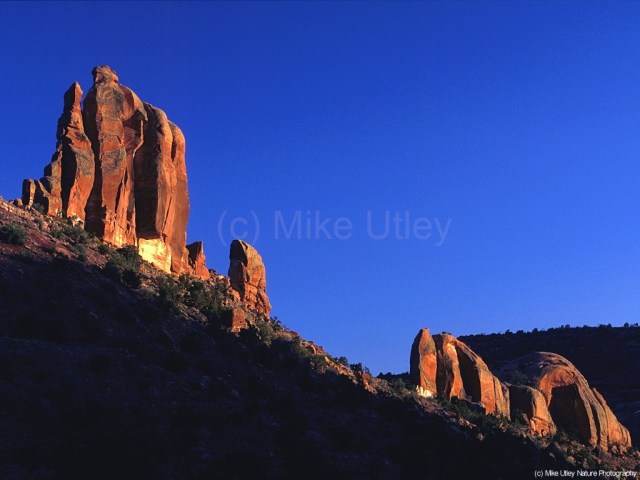
Big Indian Rock, Lisbon Valley, SE Utah (c) Mike Utley
I was raised on a farm about an hour from Lisbon Valley in southeast Utah. It’s an out-of-the-way place of red rock formations and sage-sprinkled canyons used for cattle grazing and open-pit copper mining (and yes, both activities have damaged the land considerably). I photographed this scene one summer evening in the late-1990s as the sun slanted toward the horizon and shadows encroached upon Big Indian Rock (upper left). I was intrigued by the strong diagonal slope my vantage point provided, as well as the bold blocks of color. It was a contrasting scene due to the brightly lit rock formations and the shadows, and because I was using slide film (which has a significantly narrower exposure latitude than negative film), I was unsure if I could render the scene properly exposed and still capture shadow details. The motto for photographers who use slide film is “Expose for the highlights and let the shadows fall where they may.” My goal here was to focus on composition and color, so I decided against using a graduated neutral density filter, which would have created more balance between the highlights and shadows. I thought that allowing the shadows to block-up a bit simplified the image and helped it adhere to my philosophy of quiet contemplation in nature. Busy photographs are chaotic and cause tension, and I sought peace and stillness here, so the fewer distractions, the better. There is still detail in the shadows, but not enough to distract from the tranquil feeling these rocks convey. I like the composition here, with the two rock formations standing near diagonal power-points in the scene against the brilliant blue sky and dark shadows. The rocks glow with the warm tones of the lowering sun and contrast well against the cool blue and black hues. (Canon gear, Fuji Velvia ISO 50)
Peaks & Waterfall at Sunset, Glacier National Park, Montana (c) Mike Utley
Mount Oberlin and Cannon Mountain can be found along the Going-to-the-Sun Road which traverses Logan Pass in Glacier National Park, Montana. These two peaks cradle the remnants of an old glacier that feeds Bird Woman Falls, visible between the two peaks. In this 1996 image, I was on a very rushed one-day tour of the park with a friend when we spotted this sunset scene. I had no way to compose the image with a strong foreground object as I would have preferred as I was on the opposite side of the steep valley from the peaks, so I utilized the two trees seen here to act as a sort of framing device and to divide the image into thirds to create a more pleasing shot in my mind. The fact that one tree is dead and the other thriving was incidental to my decision to include them, but they do provide a contemplative aspect to the image, especially how the waterfall seems to feed the living tree on the right, while the dead tree on the left signifies day’s end as it contrasts with Mount Oberlin’s brightly gilded face bathed in the dying day’s last light. (Canon gear, Fuji Velvia ISO 50).
Spruce Sprout on Stump, Abajo Mountain, SE Utah (c) Mike Utley
While exploring the Abajo (Blue) Mountain in southeast Utah in the summer of 1996, I came across this tiny blue spruce sprout growing on an old blackened stump. I was struck by the brilliant green—the color of youth and vitality—and how it contrasted with the dark tones of the stump—age and fatigue. The textures were also a study in contrast, with the smooth, supple flesh of the sprout defying the harsh, rough wood of the base of the old dead tree. I’m fascinated by contrasts in nature, and this mini-tableau was brimming with them. Life and death? Youth and old-age? Color and a lack thereof? Tenderness and harsh reality? Perseverance in the face of all odds? The inexorability of life where none should exist? Anyone who knows me will realize the main emotion I felt when I saw this scene was one of quiet stillness and contemplation. This sprout speaks to me on a fundamental level, telling me there is hope—always, there is hope—even in death. If we take the time to actually see what is around us in nature, we can sense change in our lives and an invigoration of our spirits…and because of this intrinsic truth, it’s all the more important that we are good stewards of our earth. Nature nurtures our souls, and once it’s gone, then there will be no more hope for us. (Canon gear, Fuji Velvia ISO 50)